

Completion Is Not Behavior: How to Measure What Changes After Training
Completion rates prove attendance, not change. How to define, observe and measure the on-the-job behavior your training is meant to produce.


Picture the quarterly business review. The learning slide shows everything the LMS can tell you: every manager enrolled in the coaching program, nearly everyone marked complete, satisfaction scores you are proud of. Then the CFO looks up and asks the one question the slide cannot answer: “So what are they doing differently?”
If you have been in that room, you know the pause that follows. In a July 2024 Chief Learning Officer article, Manasi Agarwal named a question stakeholders often put to L&D: “Tell me the change I will see after this intervention.”
You can measure behavior change after training, but not with completion data. Define the behavior before you build anything, capture how often it happens today, and look for it in the work itself. Below is a one-page evidence plan you can copy, and a way to report the result without overclaiming.
Key takeaways
- Headcounts trained and learning hours measure delivery, yet they were the most common success measures in ATD’s 2024 benchmark of 498 organizations.
- Behavior change is far easier to measure when the target behavior is defined as an observable action in a specific moment before the course is designed.
- A one-page evidence plan, agreed before launch, names the behavior, what to look for, where the evidence comes from, the baseline and the check dates.
- Line managers see the behavior every week, yet only 29% of practitioners in CIPD’s 2023 survey said managers were involved in assessing learning impact.
- Report behavior evidence as evidence and name the other possible causes openly; it is rarely proof of ROI.
Why doesn’t completion prove that training worked?
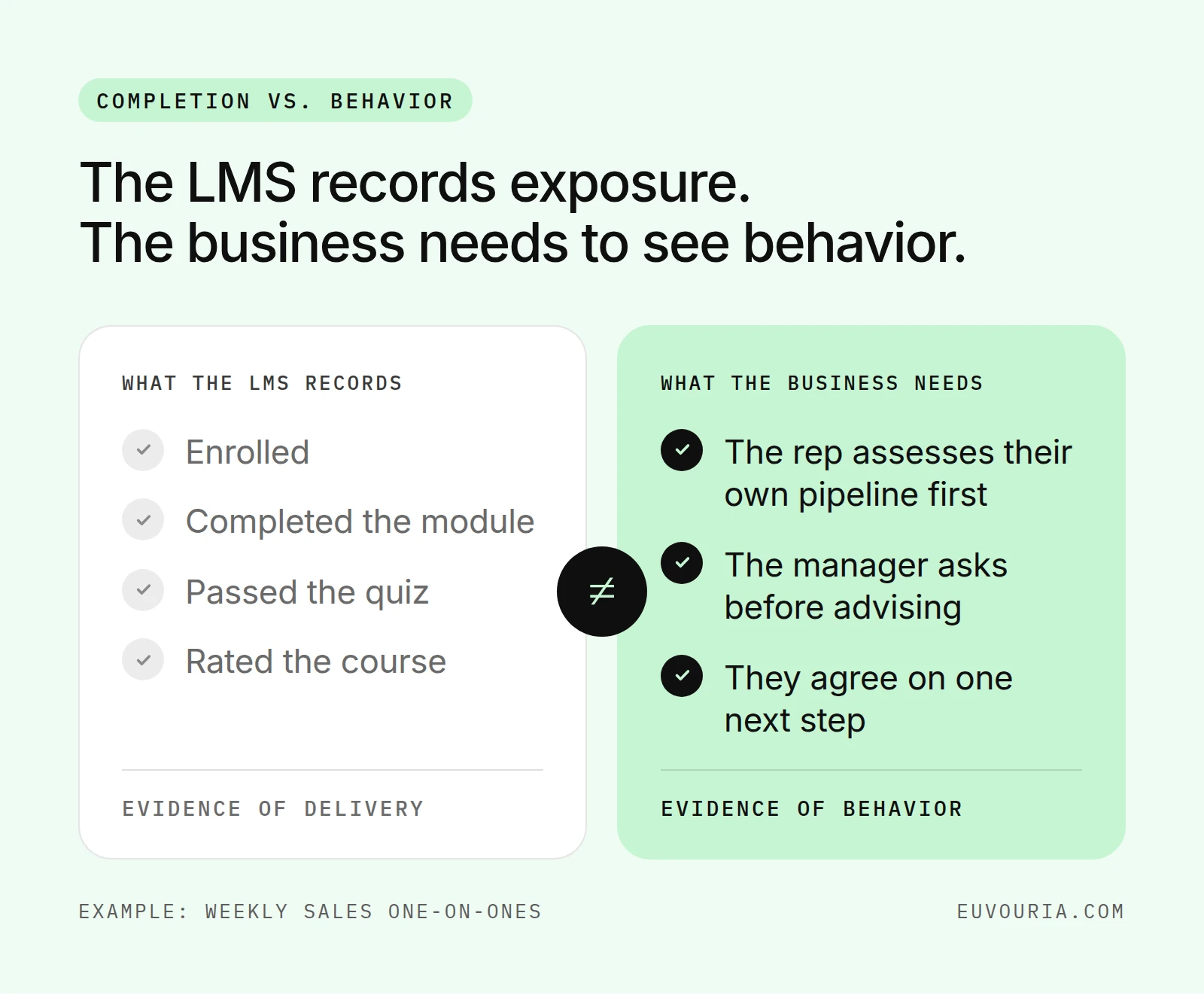
Because completion measures exposure. A learner can finish a module, pass the quiz and still handle the next difficult customer call exactly as before. The LMS records the module and the quiz; nothing records the call.
The industry still leans heavily on exposure metrics. According to the full ATD 2024 State of the Industry report, which covers 2023 data from 498 organizations, the most common measures of success were the number of employees trained (85%) and the number of learning hours delivered (74%). In a fall 2024 Training Industry article, Tom Whelan reported Training Industry survey data from 368 respondents: 55% of organizations relied on learner feedback to gauge learning impact, and 17% did not measure it at all.
Headcounts, hours and learner feedback are worth tracking as delivery and reaction metrics. The trouble starts when they are presented as evidence that people now work differently.
What should you measure instead?
Measure one behavior, in a specific moment, that the business can see. If you cannot describe it clearly enough for a manager to recognize it, you will not be able to measure it later.
Most training requests arrive as topics, such as “a course on the new escalation policy,” and a topic gives you nothing to observe afterward. Compare these two objectives:
- Topic: Advisors understand the escalation policy.
- Behavior: When a client disputes a fee on a call, the advisor acknowledges the concern, names the escalation route and logs the case before the call ends.
The second version tells you what to design: practice for that exact moment. It also tells you what to look for afterward: a logged case, a call-review score, fewer repeat complaints. In our method, this is the first phase. We turn the request into one behavior, written up as a one-page Behavioral Brief before anything else is written, and that behavior becomes the measure for everything we build.
What counts as evidence of behavior change?
Evidence of behavior change is anything that shows the behavior happening in the real workflow, compared with how often it happened before. If you use the Kirkpatrick model, this is Level 3: behavior. The evidence usually comes from three places:
- Observation. A manager, coach or quality reviewer sees the behavior in the moment: a call review, a ride-along, a sampled one-on-one.
- Traces in the work. The behavior leaves a record: a completed checklist, a CRM note, a documented escalation, a correctly filed report.
- Operational indicators. The downstream numbers the behavior should move: errors, rework, complaints, audit findings, time to proficiency.
Capture a baseline before launch, even a rough one. Without it you only have an after picture.
Agree on the signs of success before the course is built, too. Once people have seen the data, they tend to define success as whatever the data shows, and that is how dashboards end up flattering the program.
What does this look like in a real moment?
Picture a regional sales manager on a Monday morning. She and her fellow managers all completed a coaching module last month. In her one-on-ones, she still does most of the talking and ends each meeting by telling the rep what to do next.
The behavior the business needed is simple to state: in weekly one-on-ones, the manager asks the rep to assess their own pipeline first, then agrees on one next step with them. That can be observed, and it can be checked in the notes the meetings already produce.
If the course had been designed around that moment, with practice on the opening question, the silence that follows and the agreed next step, you would know exactly what to look for in her next one-on-one. If it had been designed around coaching models, there would be nothing specific to look for.
A behavior evidence plan, filled in
To measure that behavior, write a one-page evidence plan and agree on it with the business before the course is built. Here is the plan for this sales manager. Every detail is hypothetical, so replace it with your own behavior, roles and systems.
- Behavior: In weekly one-on-ones, the manager asks the rep to assess their own pipeline first, then agrees on one next step with them.
- Look-fors: The rep speaks first about the pipeline. The manager asks at least one open question before giving advice. The meeting ends with one next step the rep has agreed to.
- Evidence source: At each check, the sales director reviews five one-on-one notes per manager in the CRM against the look-fors, and asks a few reps two questions in a skip-level conversation: “Who spoke first about your pipeline?” and “What next step did you agree on?”
- Baseline: The same check on notes from the four weeks before launch.
- Check dates: About three weeks after launch, for first attempts, and again at 90 days, once old habits have had a chance to return.
- Business indicator: The pipeline measure sales leadership already watches, such as stalled deals, agreed with them in advance.
- Other factors to watch: A new incentive plan, territory changes, a CRM update.
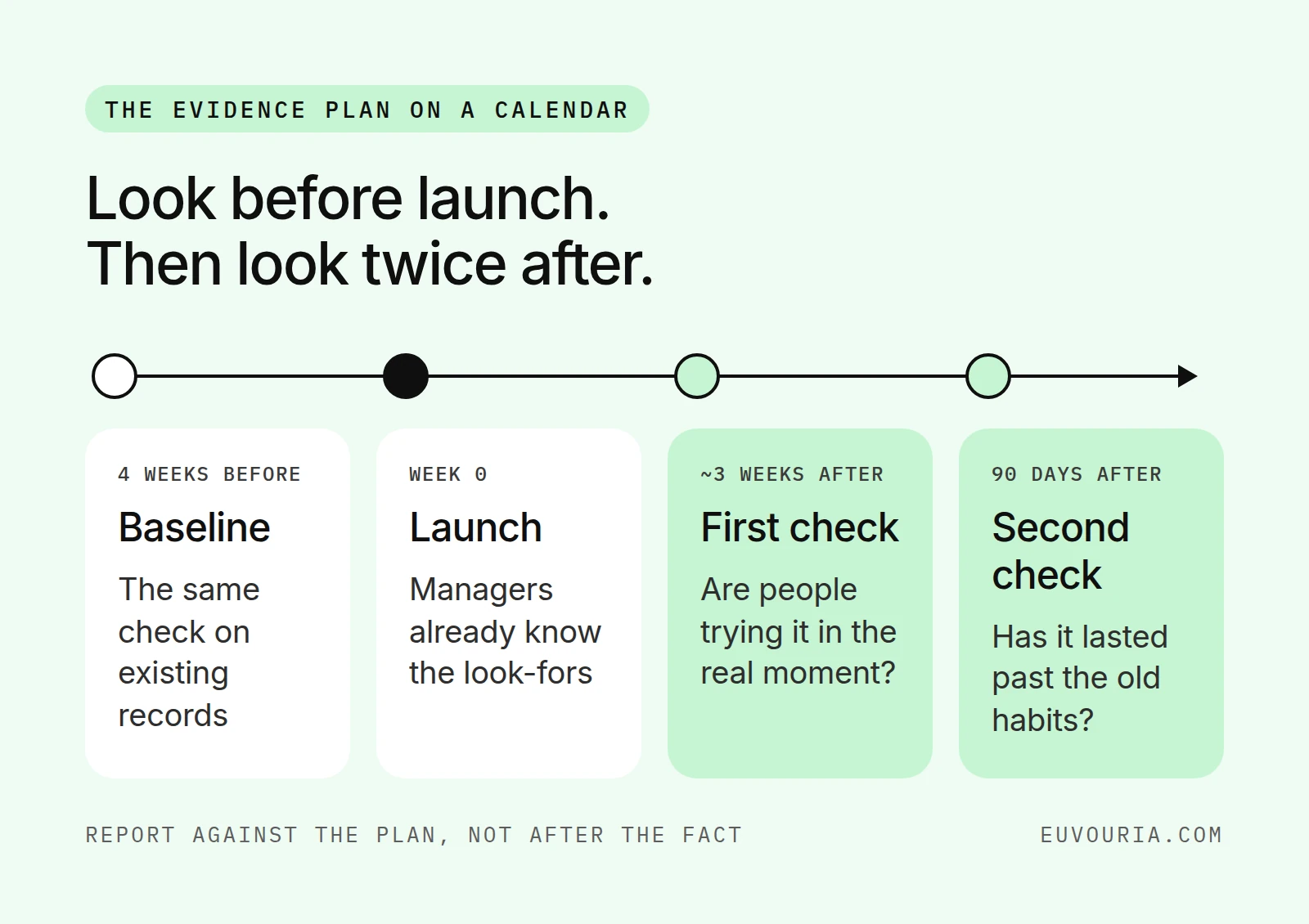
In our Behavior Bridge method, the Behavior Proof Plan in the final phase makes the behavior visible once the course is live. Agree on the plan before launch, so everyone knows what “working” will look like before anyone sees a result.
Who should be involved in measuring it?
In my view, line managers are best placed, because they see the behavior every week and they are the ones who reinforce it or let it fade. Yet in the CIPD’s 2023 Learning at Work survey of 1,108 practitioners, most of them in the UK, only 29% agreed that line managers were involved in assessing learning and development impact, and only 50% agreed they had a process for assessing learning impact at all.
29% of practitioners in CIPD’s 2023 Learning at Work survey agreed that line managers were involved in assessing learning and development impact.
Involving managers can be light. Give them the look-fors and one moment in their existing routine to use them, such as the one-on-one or the monthly quality check, and measurement happens inside work they already do.
Managers will judge differently at first. Give them the same look-fors and, in the first week, review two or three real examples together so that “good” means the same thing on every team.
How do you report behavior change without overclaiming?
Report what changed, where, and how you know. Then say what else could explain it. A new incentive plan, a system update or a seasonal pattern can move the same numbers your training was meant to move. In my view, leaders trust evidence more when you name its limits.
Report against the plan: the behavior, the baseline, what you saw at each check, the indicator it connects to and the other factors you know about. The next time someone looks at your learning slide and asks what people are doing differently, you can answer with a behavior, a baseline and what managers saw. A client described the shift in these words (Director of Learning, Multinational Pharmaceutical Company):
“Before Euvouria, we could prove our compliance training was completed and nothing else. Now we walk into the board with evidence that behavior changed.”
If you already have a course live and a stakeholder asking what changed, request a free diagnostic of one module. We will send you the three highest-impact improvements to that module within one to two working days.
FAQ
Should we stop tracking completion?
No. Completion is still useful, and in regulated industries it is often needed as audit evidence. Report it as evidence that training was delivered.
What if the course is already live and there is no baseline?
Build one from records that existed before launch: call reviews, CRM notes, quality samples or audit findings from the weeks before the course. If none exist, run the first check now and treat it as the baseline for the next cycle.
What if I can’t get to the data I need?
Start with the evidence managers can collect in their existing routines, which needs no system access. Then ask the data owner for the one field that matches your behavior; a narrow request is easier to approve than a new dashboard.
Can you prove that the training caused the change?
You rarely can with certainty. A comparison group, a staggered rollout or a clear baseline makes the case much stronger. Where none of those is possible, present the evidence honestly and name the other factors that may have contributed.

Your people already sat through the training. Now get them to actually do it.
We design learning that changes what your people do on the job. No deck. No pitch. A real conversation about your people and what you need them to do differently.