

Compliance Training Effectiveness: Why Completed Courses Still Fail
Compliance training effectiveness is decided in the seconds a friendly request meets a rule. Build that moment into a course you already have, and check it.


Picture the week your compliance dashboard finally goes fully green. On Thursday, a field rep crosses a hospital corridor on a ride-along, her manager a few steps behind. A physician she knows well asks for a “quick favor” that the code of conduct says to decline, and because saying no would feel rude, she says yes.

If you have owned that dashboard, you know the pause when someone asks what the green actually tells you. The honest answer is short: who finished the course.
In my view, compliance training effectiveness is decided in the few seconds when a friendly, hurried request meets a rule. A course can explain the policy, be fully completed and still fail if it never rehearses that moment. With a one-page card and a simple check at work, you can design that pressure point into a course you already have.
Key takeaways
- A fully green completion dashboard shows who finished the course and says nothing about what people do when a friendly colleague asks for an exception.
- In a 2026 TalentLMS survey reported by HR Dive, 45% of the 1,000 U.S. workers polled said the compliance training that exists is disconnected from real situations employees face.
- Effective compliance training is built around one pressure moment: the signal, the decision, the exact words and the consequence.
- A one-page pressure-point card lets you add that moment to a course you already have, without rebuilding it.
- A practical check is to have managers or peers look for the same observable sign about three weeks after launch and again at 90 days.
Why does compliance training fail when everyone completed it?
Completion is recorded in one place and the rule is tested in another. The LMS logs the last screen of the module, while the rule gets tested weeks later, in a chat window or a corridor, when someone the learner likes asks for an exception. In plain words, that is click-through compliance training: the course is finished and the decision it was meant to prepare people for has never been practiced.
In a survey of 1,000 U.S. workers by the employee training platform TalentLMS, released in January 2026 and reported by HR Dive in February 2026, 60% said compliance training leads to better behavior at work, while 45% said the training that exists is “disconnected from real situations employees face.” Both figures are self-reported opinions from a vendor's survey, and neither measures behavior.
45% of the 1,000 U.S. workers polled in a 2026 TalentLMS survey, as reported by HR Dive, said the training that exists is “disconnected from real situations employees face.”
Compliance officers are wary of simple answers too. In an open-access 2025 Journal of Business Ethics article by Malouke Esra Kuiper, based on semi-structured interviews with compliance officers, none of the interviewed officers believed in a quick fix for compliance. Its literature review, citing earlier work, notes that judging whether ethics and compliance training works is complex because different outcomes can be used to evaluate it.
If completion is the outcome, every course passes. Judging what people say and do takes a defined moment and a baseline, and I set out the steps in how to measure what changes after training.
What actually happens in the moment a rule bends?
Rules bend at a pressure point: a signal arrives, someone has seconds to decide, and the words that would hold the line are not on hand. I find it helps to break that moment into four parts.
- Signal: the phrase or situation that means a rule is in play (“quick favor”, “I'll sign it Monday”).
- Decision: what the person must choose, usually within seconds.
- Exact words: the sentence that holds the line without damaging the relationship.
- Consequence: what happens next, for the person and for the standard.
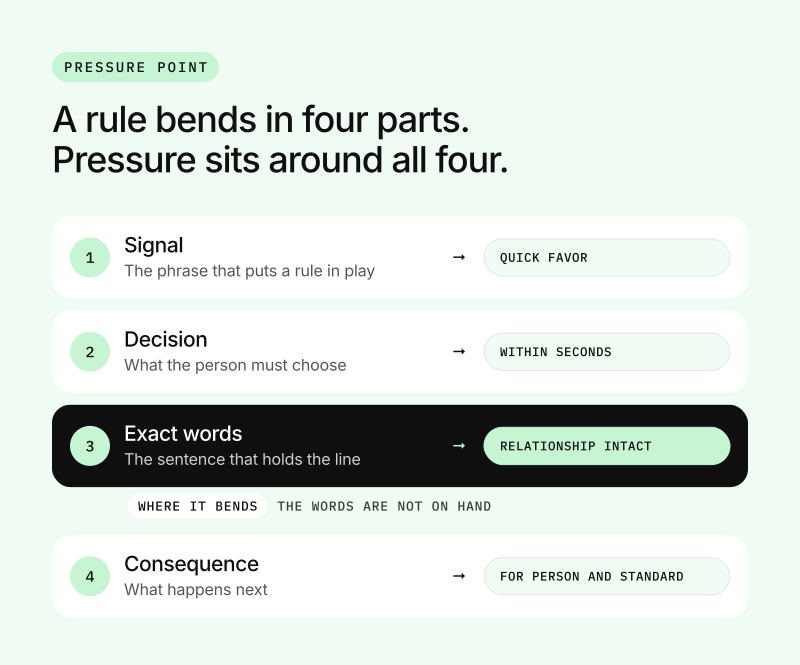
Pressure sits around all four. When the request comes from someone you like, with a manager watching or a client waiting, the easy answer feels like the polite one, and in the corridor the rep had no sentence ready for a physician she will see again next week.
In my view, a policy page tells people what the standard is, and a rehearsed sentence is what lets them hold it in that moment. A quiz on the policy tests only the first.
How does one pressure moment play out on a Friday afternoon?
Take one behavior in one moment and write down exactly what the person says and does, with and without rehearsal.
Picture a payments operations analyst at a bank, three months into the job. Late on a month-end Friday, the office has emptied and her queue is nearly clear. A senior colleague who helped her in her first weeks messages her in the team chat: “Can you release this one? I'll get the second sign-off Monday, the client is waiting.”
- Without rehearsal: She releases the item to be helpful, her course record stays complete, and the second approval happens after the fact, if at all.
- With rehearsal: She spots the signal, says the sentence she has practiced (“I can release it as soon as the second approver signs. I'm pinging them now and copying you.”) and logs the request.
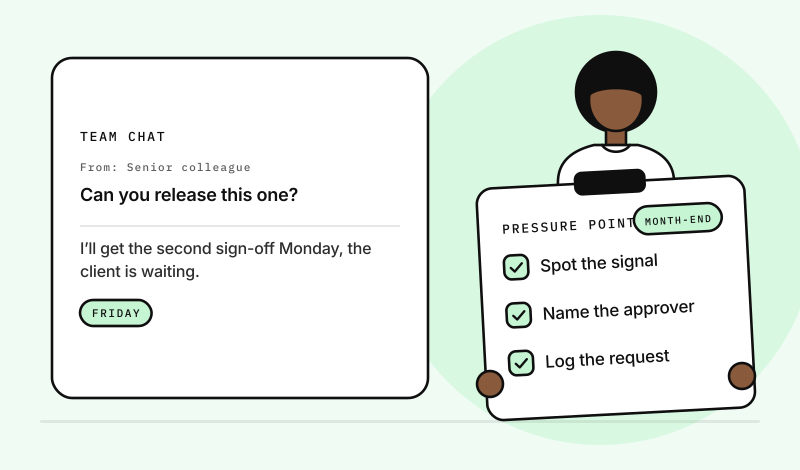
Nobody is embarrassed in the second version, because she offered her colleague a next step and kept him in the loop while the item waited for the approver. Her manager can see the habit later in the chat thread.
How do you build a pressure-point card for a course you already have?
Fill in a one-page card with seven fields for one behavior, then add that moment to the existing course as a single scenario decision, leaving the rest of the course as it is. Start by rewriting the objective as a behavior in a moment, because a recall objective is easy to pass without anything changing at work.
- Instead of: “Learners will know the approval rule.”
- Try: “When a senior colleague asks to skip the second approval, the analyst says one sentence that keeps the step and names the approver.”
Here is the card for the Friday scene. Every detail is hypothetical, so replace it with your own role, signal and wording.
- Moment: Late Friday at month-end, a senior colleague asks the analyst in the team chat to release an item before the second approval.
- Signal: “I'll get the second sign-off Monday.” Any request to do the step now and approve later.
- Pressure: A colleague she likes, an empty office, a waiting client and a request that sounds reasonable.
- Decision: Release now to help, or hold the item for the second approver.
- Exact words: “I can release it as soon as the second approver signs. I'm pinging them now and copying you.”
- Consequence: The item waits, the approval is recorded before release, and the colleague knows where she stands. If she releases early, the gap is hers and the team's to explain.
- Look-for: She states the approval step and names the approver before release, which a manager can see in the chat thread or a peer can hear in a role-play. Check against a baseline at about three weeks and at 90 days.
In the course, the card becomes one decision: the chat message appears, the learner picks a reply, and the consequence plays out, including what happens to the working relationship. I find the tempting wrong answers matter as much as the right one, so write them the way a helpful, tired person would reply.
If the course is mandatory regardless, keep it. The requirement settles whether people take it, and what it must cover stays with your compliance and legal owners; the card only decides which moment one part of it rehearses.
How do you measure compliance training effectiveness without new systems?
Use the look-for from the card, take a baseline, and have managers or peer reviewers check the same sign about three weeks after launch and again at 90 days. That timing is my recommendation, and none of it needs an HRIS integration or a data request.
- Baseline: Before you add the scenario, run a short role-play of the Friday message or review a sample of recent release requests.
- Three weeks: A manager or peer reviewer checks the same look-for while first attempts are fresh.
- 90 days: Check again, once month-end pressure and old habits have had time to return.
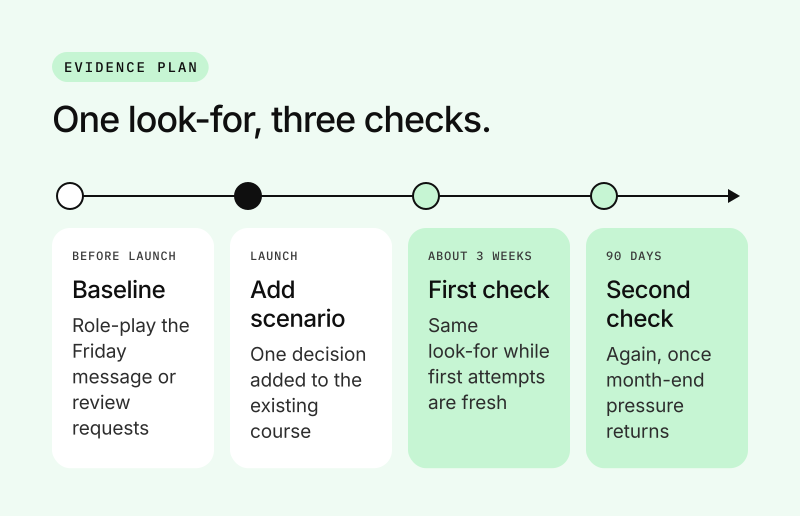
How much evidence is enough? In my view, one behavior, one baseline and two observation points tell a leader more than a dashboard of activity metrics. Keep completion as your record that training was delivered, and report the look-for with other possible causes named.
I won't claim that a study proves rehearsing one sentence changes what people do at work. The baseline and the two checks are how you find out for your own team.
In our Behavior Bridge method, this work belongs to the second phase, Map the Obstacles, where we map habits, friction, pressure and unclear standards into a Behavior Map, the course blueprint. The pressure-point card does that job for a single moment.
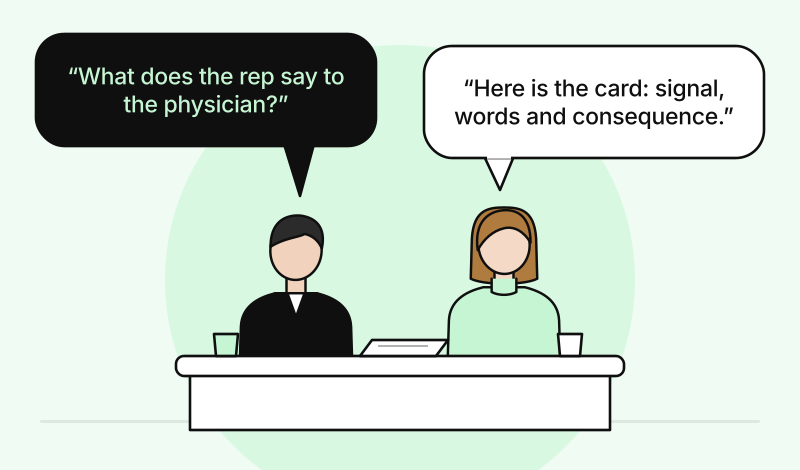
The next time your dashboard goes green, you can ask what the rep says to the physician in the corridor and who she tells afterward, and you will have a card that names the signal, the words and the consequence.
If you have a compliance module that shows complete across the board and want to see where it leaves out the pressure moment, request a free diagnostic: send us that one module and we will return the three highest-impact improvements within one to two working days.
FAQ
Is this a coaching issue or a training issue?
If nobody has rehearsed the sentence, it is a training issue, and the card is a good place to start. If people can say it in a role-play and still don't at work, the cause is more likely a manager, a target or an incentive, so diagnose whether it is a training problem before you add another scenario.
Which pressure moment should we start with?
In my view, start with the moment your compliance owners worry about most, where the request comes from someone people like or report to. One moment done well tells you more than five done thinly.
What if we can't get behavior data from other systems?
Start with what a manager or peer can observe: a role-play answer, a chat thread, a short question in a one-on-one. Use the same look-for at every check, and add system data later if you can reach it.

Your people already sat through the training. Now get them to actually do it.
We design learning that changes what your people do on the job. No deck. No pitch. A real conversation about your people and what you need them to do differently.