

Is It Really a Training Problem? Diagnose Before You Build a Course
Training fixes skill gaps, not broken tools or bad incentives. Five questions to ask before you build a course, and what to do when the answer is no.


The request lands on a Thursday afternoon, forwarded twice before it reaches you. Complaints are up again. Could L&D put together a short course on the escalation process, ideally live before the end of the quarter? Nobody has asked the obvious question: is it a training problem at all?
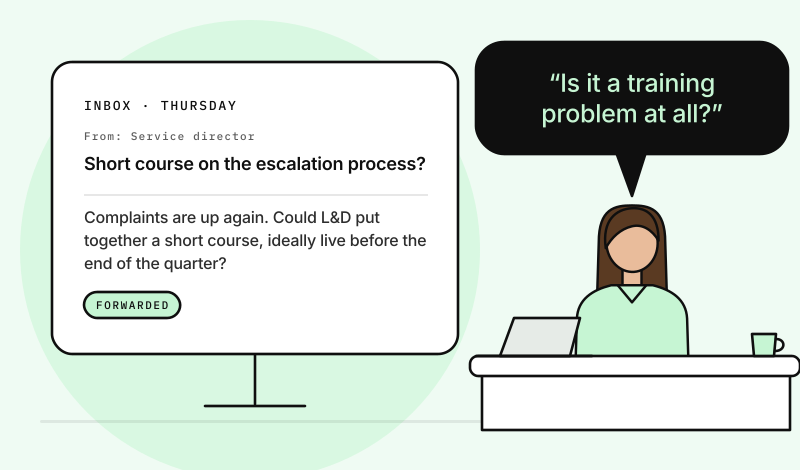
You could build it. You would hit the date, completion would look fine, and three months later the stakeholder would ask why complaints have not moved. Emma Howard, Group Head of Talent and Development at LGC, named the pattern in a webinar recap published in March 2024 by the training company Aperian: “Often, things fall into a learning and development bucket that aren’t learning and development.”
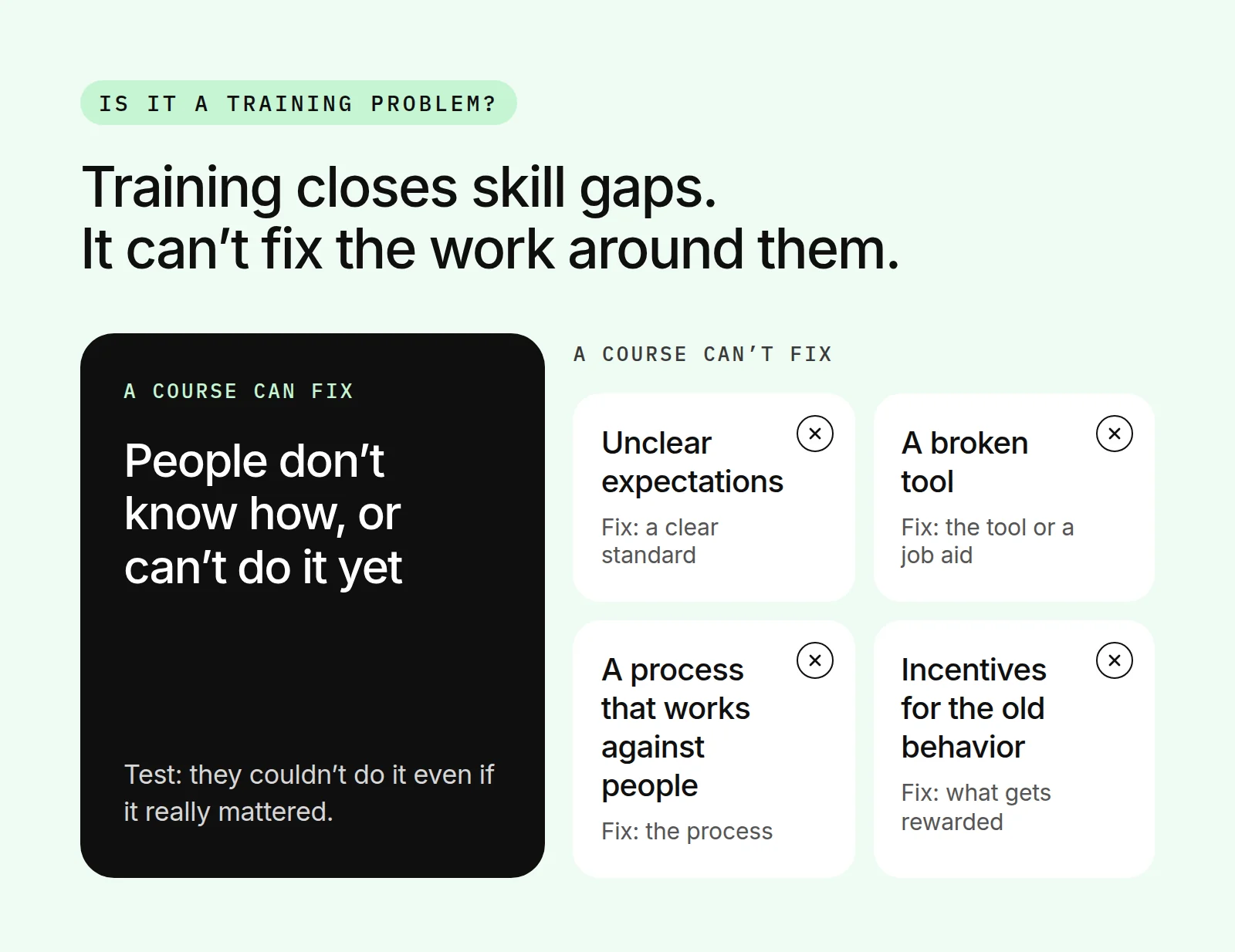
Training closes gaps in skill and knowledge. It cannot fix unclear expectations, a broken tool, a process that works against people, or incentives that reward the old behavior. So diagnose before you build. Below are five questions, a one-page diagnosis you can copy, and what to do when the answer is no.
Key takeaways
- A training request describes a solution; a diagnosis starts from the behavior the business actually needs to see.
- If people could perform the behavior when it really mattered, the problem is not a skill gap, and a course will not fix it.
- Consequences, obstacles and missing feedback in the workflow can explain performance problems that get labeled as training needs.
- Most real problems need a mix: training for the skill, plus changes to tools, process or management routines, each with an owner.
- A one-page diagnosis makes it easier to say “not a course” to a stakeholder, and easier to measure the result when it is one.
Why do so many training requests miss the real problem?
Because a training request is a proposed solution, not a description of the problem. Someone has noticed a symptom, such as errors in a report, a spike in complaints or managers avoiding difficult conversations, and a course is the most familiar response L&D can offer.
Some learning leaders push back early. In a 2025 Learning Guild Q&A, Dr. Becky Burke, VP Learning & Strategic Development at BankWest, listed what Burke’s team asks when someone requests a training program: “Is the training necessary?” and “Is this a coaching issue or a training issue?”
In my view, that is the habit worth building: before you agree to help, ask whether a course is the help the stakeholder needs.
How do you tell whether it is a training problem?
Ask five questions, in this order. Each answer points to a different cause, so by the end you know whether a course can help, what else has to change and what the course needs to do.
- What exactly should people do differently, and in which moment? Replace the topic with a behavior. “Understand data privacy” becomes “When a colleague asks for a client file by email, the analyst shares it through the approved secure channel.” If the stakeholder cannot describe the moment, the first job is to find it.
- Could they do it if it really mattered? This paraphrases the classic test in Robert Mager and Peter Pipe’s 1970 book Analyzing Performance Problems, and I find it the most useful question in the diagnosis. In a January 2026 Training Magazine article, Mike Saunderson set out a seven-question framework based on their model. If people can perform the behavior when someone is watching or the stakes are high, they have the skill, and something else is stopping them.
- What happens to them when they do it, and when they don’t? If the right behavior is slower, riskier or unnoticed, and the wrong one is rewarded or ignored, people will keep doing the wrong one after any course.
- What gets in the way in the moment? Look for friction: the tool that takes six clicks, the policy nobody can find, two standards that contradict each other, a target that pushes people to cut the corner.
- Who will notice whether it happens? A behavior that nobody observes or gives feedback on will fade, however well it was trained. If no manager or system will notice, build that in or expect the change to disappear.
Only a clear “no” to the second question points to a genuine skill or knowledge gap. The other answers tell you what has to change in the work, with or without a course.

What does the diagnosis find in a real request?
Picture a request from a commercial team at a pharmaceutical company: a refresher on how field representatives respond when a healthcare professional asks about an unapproved use of a product.
A diagnosis might find that representatives know the policy well; they can recite it in a quiz. What trips them up is the moment itself: the question comes in the middle of a friendly conversation, the rep has no practiced wording for redirecting it, and passing the question to the medical team takes long enough that reps are tempted to improvise.
That produces two actions. The training focuses on practicing the exact response in realistic conversations, with consequences and feedback. The workflow gets a faster, simpler way to refer the question through the company’s approved process for unsolicited requests.
What does a one-page diagnosis look like?
The diagnosis fits on one page: five questions, one answer each, and an action with an owner for every answer. Here is the diagnosis for the pharmaceutical request above. Every detail is hypothetical, and the approved response is whatever your medical, legal and regulatory reviewers have set, so replace it with your own request.
- Request, as received: A refresher course on responding to questions about unapproved uses.
- Behavior and moment: When a healthcare professional asks about an unapproved use during a visit, the representative redirects with practiced wording and refers the question through the approved process. Action: this becomes the course objective and the thing to measure.
- Could they do it if it really mattered? They know the policy, but they have never practiced the conversation. Action: training, built on realistic conversations, owned by L&D.
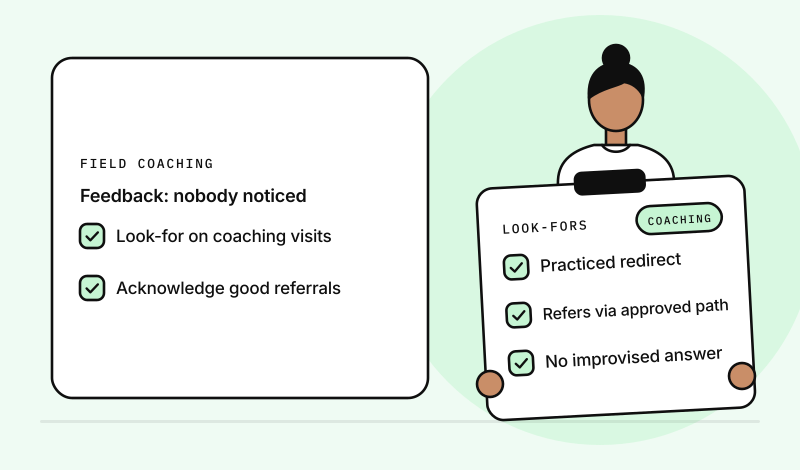
- Consequences: Improvising keeps the visit friendly; referring feels slow and awkward. Action: field managers acknowledge good referrals in coaching, owned by the sales leader.
- Obstacles: The referral route takes too long. Action: a simpler referral path, owned by the process owner in medical affairs.
- Feedback: Nobody notices unless a referral goes wrong. Action: the moment becomes a look-for on field coaching visits, owned by field managers.
- Signs of success and check dates: More questions referred through the approved route and fewer improvised answers seen in coaching, checked about three weeks after launch and again at 90 days.
Read it like this: a “no” to “Could they do it?” points to training; a consequences problem points to incentives or recognition; an obstacle points to a job aid, process or tool fix; missing feedback points to a manager routine. In our Behavior Bridge method, the second line of this page, the behavior and its moment, is what the Behavior Workshop produces: a one-page Behavioral Brief with a measurable behavior goal.
What should you do when it isn’t a training problem?
Say so, and offer what will work. A 2021 ATD blog post on needs assessments makes the same point: each set of needs will likely include some that “require non-training solutions.”
Depending on your answers to the five questions, the better intervention might be a job aid at the point of work, a process fix, a clearer standard, a change to what managers ask about in one-on-ones, or an incentive that stops rewarding the old behavior. None of these is as visible as a new course, but any of them can do more than a course that changes nothing.
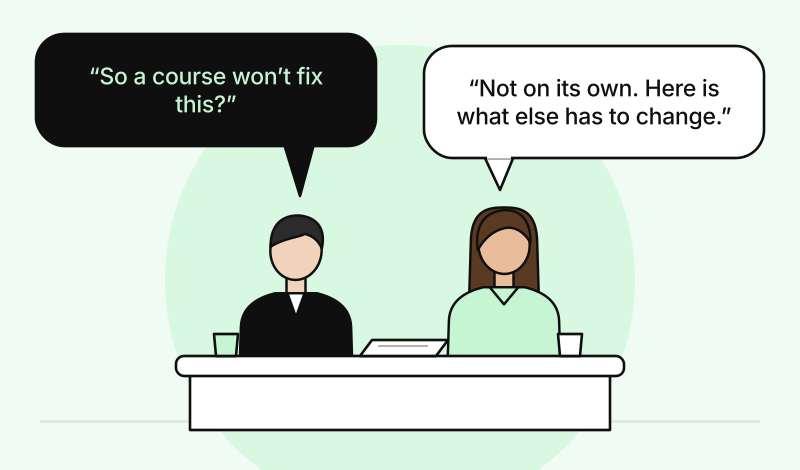
Put the one-page diagnosis in front of the stakeholder. It keeps the conversation on the problem, gives every fix an owner and gives you something to measure against later. It is a better reply to that Thursday-afternoon email than a project plan, and it is where measuring behavior change after training really begins.
When it is a training problem, what changes about the course?
Everything you learned in the diagnosis shapes the design. The moment tells you which scenario to build. The obstacles show what learners need to practice getting past, and the consequences suggest what feedback the course should give.
At Euvouria, this is the second phase of our Behavior Bridge method. We map the obstacles between current and desired behavior before we write a single screen, and the result is a Behavior Map, the blueprint for the course.
If the request on your desk is to refresh a module you already have, send it to us for a free diagnostic. We will send you the three highest-impact improvements to that module within one to two working days.
FAQ
Is a performance diagnosis the same as a training needs assessment?
They overlap. A needs assessment usually looks wider and feeds a broader learning plan. The diagnosis described here is narrower and faster: it tests one request against one behavior to decide whether training is the right tool.
How long should a diagnosis take?
For a single request, plan on two or three conversations and a look at the work itself: a sample of calls, reports or records. That is a few days of work. If it takes longer, the problem is probably bigger than one course.
What if the stakeholder still insists on a course?
Build the smallest version that targets the real behavior, and agree up front on the signs of success you will look for. If the obstacles you found are still in place, the evidence will make that visible, which makes the next conversation easier.
What if the training is mandatory anyway?
Then the requirement settles that there will be a course, and the diagnosis still shapes what it does. Build it around the real moment the policy covers, and fix what the diagnosis found alongside it. Completing the course satisfies the requirement either way, so the design is what decides whether behavior changes.




Your people already sat through the training. Now get them to actually do it.
We design learning that changes what your people do on the job. No deck. No pitch. A real conversation about your people and what you need them to do differently.