

Why Your Custom E-Learning Development Cost Quotes Never Compare
Custom e-learning development cost quotes differ because each vendor priced a different course. Use one seven-row sheet to put all three on the same page.


Picture Thursday afternoon. Procurement forwards three proposals for the same compliance course with a note: “Your VP needs a pick by Monday.” One prices per finished minute, one per module, and one tucks review rounds into an hourly rate, so the totals look like three different projects.
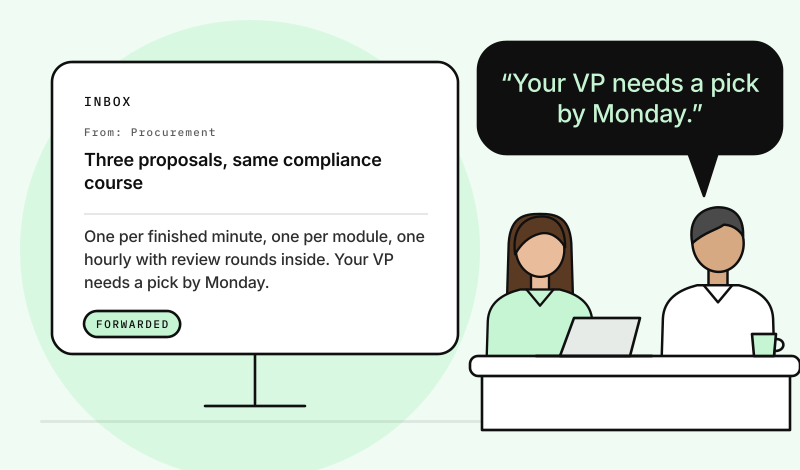
If you have been there, you know the comparison tab that stays half empty because no two rows measure the same thing (and the cheapest total is the one you trust least).
Custom e-learning development cost looks slippery across proposals because each vendor priced a different course. Compare scopes before totals: fix the finished minutes and the assumptions behind them, then have every vendor price that same page. You'll leave with a seven-row sheet you can send to all three on Thursday night, and a plan for what to tell your VP on Monday.
Key takeaways
- Three quotes for the same custom e-learning course rarely line up because each vendor priced a different scope, so agree on the scope before you compare totals.
- Finished minutes, the time a typical learner needs to complete the course, is the one unit every quote can be converted into, once each vendor says how it counts length.
- According to Voctus Insights in June 2026, custom e-learning ran roughly $83 to $500 per finished minute among the few vendors that publish rates, so a published price helps only when its scope sits next to it.
- A seven-row sheet puts three quotes on one page and turns every unstated assumption into a written question.
Why does custom e-learning development cost differ so much between quotes?
Because each quote prices a different scope, even when all three carry the same course title.
In a buyer's guide to e-learning development cost published on October 13, 2026 by the UK supplier Capytech, Jason Satterly puts the rule plainly: “Two quotes can only be compared when they cover the same scope, so agree the scope before you compare the totals.”
A June 2026 cost review on the insights page of the studio Voctus puts custom e-learning development at roughly $83 to $500 per finished minute, based on the handful of vendors who publish rates, and says quotes for the same course differ by a factor of six. Since it rests on a few vendors' own numbers, I'd use it for orientation only.
In my view, the cheapest per-minute quote is the one to question first if it doesn't state review rounds or what it expects from your SMEs. Work nobody priced still has to happen, and when it does, it lands on your team's calendar or comes back as a change request.
One step comes before any of this: check whether training is the right fix before you compare vendors.
What is a finished minute, and why does it settle half the argument?
A finished minute is the time a typical learner needs to complete the course. All three quotes can be converted into it, once each vendor tells you how it counts length.
The Capytech guide measures length the same way and adds a warning worth pasting into your email to vendors: agree how length will be measured, because “one supplier’s 20-minute module can be another’s 30.”
- Instead of: ranking three totals that each cover a different scope.
- Try: writing one scope and asking each vendor to price that scope in finished minutes and a named interaction tier.
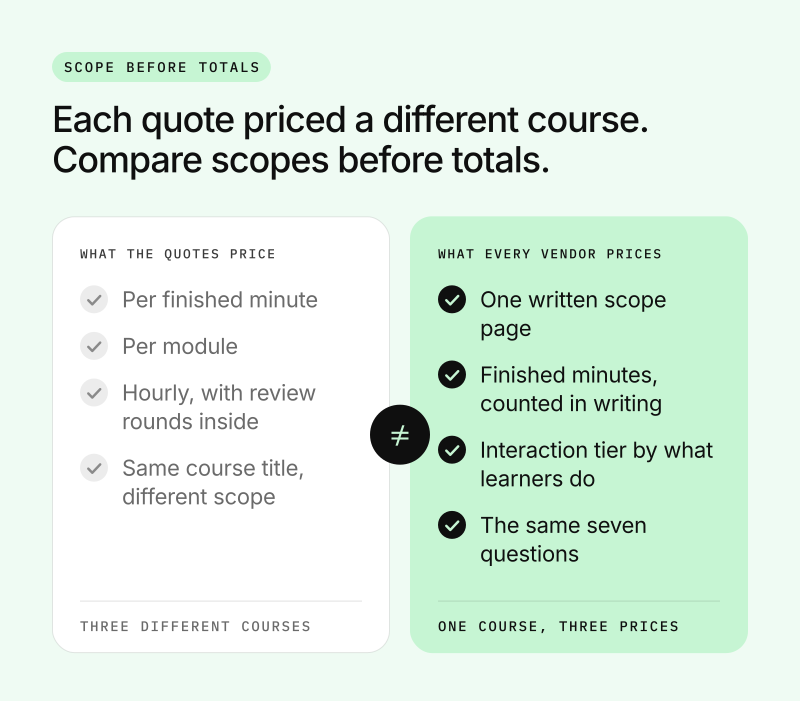
Pin down interaction tier next. The same guide describes a ladder with text, images and knowledge checks at one end, click-and-reveal and drag-and-drop activities in the middle, and more involved designs beyond them (a vendor's “Level 2” is not a unit of measure, however confidently the proposal uses it).
The tier drives effort. In an August 2026 LearnFrame article on what training programs cost, Paul Robinson reports the 2010 Chapman Alliance study of 249 organizations and nearly 4,000 learning professionals: around 79 hours to produce one finished hour of basic e-learning, and an average of 184 hours for interactive material.
Robinson notes that these are US organizations reporting their own internal cost of production. So I read the figures for one thing only: in 2010, interactivity more than doubled the effort.
$83 to $500 per finished minute, the range Voctus Insights reported in June 2026, based on the handful of vendors who publish rates.
Which hidden assumptions move the price most?
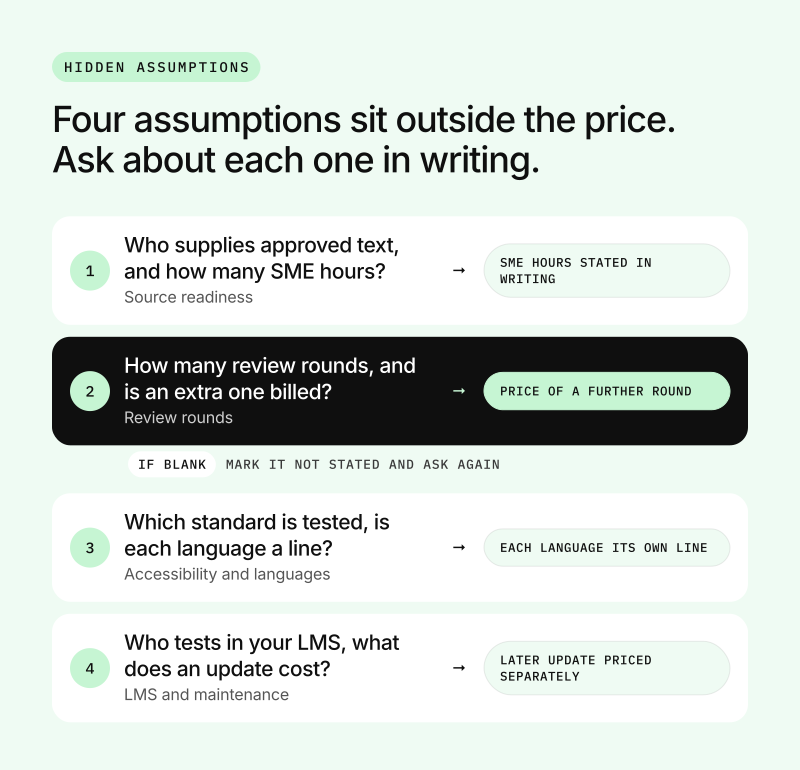
Four assumptions can sit outside the headline price: source readiness, review rounds, accessibility and languages, and LMS work with later updates. Ask about each one in writing.
In an October 2026 guide to custom e-learning costs from the Dutch company Ldesign Media, Luuk Verhoeven advises asking for a budget in which components such as content and didactics, design and production, and review and testing are visible.
- Source readiness: Who supplies the approved text, and how many SME hours does the vendor assume from you?
- Review rounds: How many are included, who consolidates the feedback, and is an extra round billed?
- Accessibility and languages: Which standard is tested, and is each language its own line item?
- LMS and maintenance: Who tests the package in your LMS, and what does a later policy update cost?
“We don't have our source content ready, so how can anyone price it?” Say exactly that in the source row and ask each vendor what it assumes, in writing. The less ready your text and your SME are, the more of the price rides on that row.
How do you turn three quotes into one comparison?
Write one scope page, send the same seven questions to every vendor in writing, and fill one row per question. Work out a price per finished minute only after the rows are filled, and send every “not stated” back as an open question.
Now picture Friday morning for a Director of L&D at a regulated multinational who sent that page and those seven questions to all three vendors the night before. One vendor answers every row and says which items cost extra. Another answers most rows but leaves review rounds blank, and the third writes “as needed” on three rows next to an hourly rate.
She doesn't rank them yet. She puts the answers on one sheet, marks each blank “not stated” and calls procurement with a short list of follow-up questions.
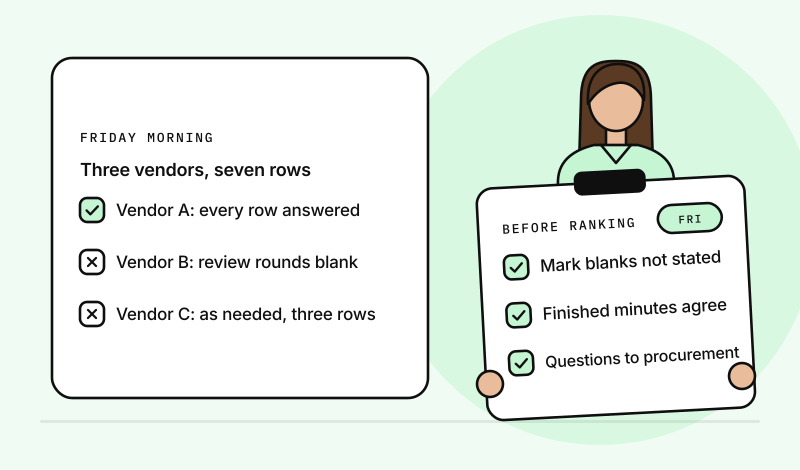
Without the sheet, the lowest total would have won on Thursday night, and the unpriced SME rounds and LMS testing would have come back months later as change requests.
The seven-row quote sheet, filled in for her course
Her course is about declining a client's gift and logging it. Every detail is hypothetical, so swap in your own behavior, people and systems.
- Finished minutes: 30 minutes for a typical learner, with each vendor confirming in writing how it counts length.
- Interaction tier: Branching decisions with consequence feedback for the client conversation, described by what the learner does rather than by a level name.
- Source readiness and your time: Approved policy text is ready and one named SME is available for a review window; each vendor states how many SME hours it assumes.
- Review rounds: One consolidated review before build, plus the number of included rounds, who consolidates feedback and the price of a further round; a blank cell becomes “not stated”.
- Accessibility and languages: The accessibility standard tested and how; one language now, with a possible second later as a separate line.
- LMS and maintenance: Who tests the SCORM package in your LMS, whether editable source files are delivered, and what a later policy update costs, priced separately.
- Price basis: Once rows one to six are filled, each total divided by its finished minutes in one column, with the open cells listed underneath.
I'd skip any ranking until the finished-minutes row agrees across all three. Until then, the last row divides three totals by three different ideas of a minute.
The sheet works only if every vendor prices the same behavior. In the first phase of our Behavior Bridge method, a Behavior Workshop turns a vague request into one behavior people must perform, written up as a one-page Behavioral Brief with a measurable behavior goal.
Attach your own version of that page to the sheet. If the sentence itself is the hard part, here is how to write the behavior in one observable sentence.
Where does a public price fit on that sheet?
A published price is a usable reference point only when its scope is stated next to it. Euvouria's public Pilot is $12,000 for one production-ready 30-minute Articulate Rise course around one behavior, in two focused weeks.
The arithmetic is mine: $12,000 divided by 30 finished minutes is $400 per finished minute, inside the range Voctus reports. Whether that's good value depends on the other six rows, so I'd leave the claim there.
Our published method answers part of the sheet: one consolidated review before build, testing for function, brand, accessibility and LMS readiness, and SCORM plus editable source files at delivery. For every row it leaves open, ask us the same seven questions you ask everyone else (we'd think less of you if you didn't).
What do you send your VP by Monday?
Send one page: the quote you'd pick, the assumptions you accepted, and the cells still marked “not stated” with the date each vendor will answer them.
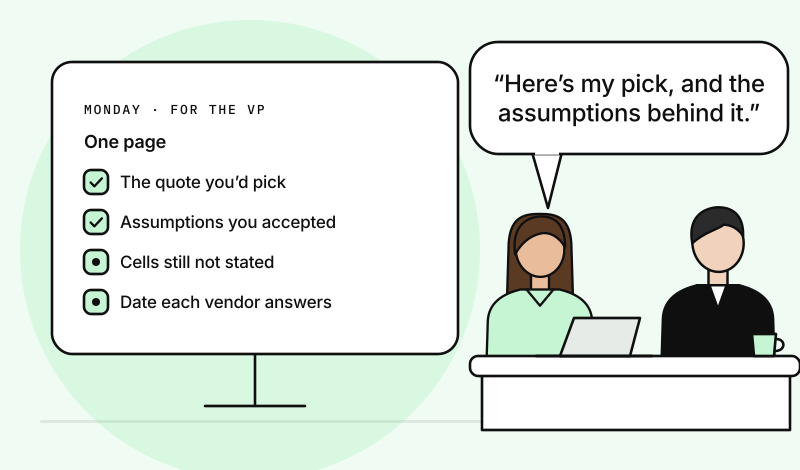
“Fine, but my VP wants a recommendation by Monday.” Then work backward. I'd send the sheet Thursday evening, ask for written answers by noon Friday, and list any row still empty on Monday as a risk with the vendor's name next to it.
“The vendors won't show me their hours.” Ask for hours and rate separately anyway; a refusal to itemize is information too. If someone still won't, compare on price per finished minute once the other rows are filled, and attach what that vendor left unstated.
Your VP then gets to argue with an assumption, which is a far better meeting than arguing with a total.
So on Monday morning, “why are these so far apart?” has an answer: one sheet, seven rows, three vendors pricing the same course, and a few honest “not stated” cells already turned into questions. This week, write the one-sentence behavior and send the sheet to all three.
If the course you're scoping replaces a module you already have, send that one module for a free diagnostic and get the three highest-impact improvements within one to two working days.
FAQ
How much does custom e-learning cost per finished minute?
As of June 2026, the Voctus review put it at roughly $83 to $500 per finished minute, based on the handful of vendors who publish rates. Our public Pilot works out to $400 per finished minute ($12,000 divided by 30 minutes).
How do I compare a per-module quote with a per-minute quote?
Convert both to finished minutes after each vendor confirms in writing how it counts length, since the Capytech guide warns that one supplier's 20-minute module can be another's 30. Then compare only quotes with the same interaction tier and the same answers in rows two to six.
Do the old Chapman Alliance numbers still apply?
Only as a guide to relative effort. LearnFrame notes the data was collected in September 2010 and reflects US organizations' internal production cost, and the Capytech guide says that, in its authors' experience, modern authoring tools and AI have shortened parts of the process. Use the ratios to compare tiers with each other, and keep them out of any price conversation.




Your people already sat through the training. Now get them to actually do it.
We design learning that changes what your people do on the job. No deck. No pitch. A real conversation about your people and what you need them to do differently.