

Behavioral Learning Objectives: If No One Can See It, Rewrite It
Behavioral learning objectives, rewritten from the moment on the job: before-and-after examples, a four-question worksheet and one test a manager can apply.


“Participants will understand the new escalation policy.” That's the objective in the sponsor's draft, which arrived Monday morning under the subject line “Quick one.” On the kickoff call you ask what understanding would look like on a busy Thursday afternoon, and after a long silence someone offers, “We could add a quiz.”

Nobody on that call is being difficult. My view: the silence after your question is the most useful minute of the whole project, because it is the first time anyone notices they have been agreeing on different things.
Behavioral learning objectives fix this, if you write them from the moment on the job. Name the moment and the action, then apply one test: could a manager see it happen? Below are before-and-after rewrites, a four-question worksheet for any sponsor's draft, and a reply for when “understand” has to stay.
Key takeaways
- An objective that says “understand” lets every reviewer approve the same words while picturing different behavior, so the disagreement surfaces only after the course is built.
- A behavioral learning objective passes one test: a manager could watch a named person do it in a specific moment on the job.
- When a sponsor insists on “understand,” keep that wording as the headline goal and add the observable behavior as a second line.
- Before launch, agree on who will observe the behavior and where they will note it, with checks about three weeks after launch and at 90 days.
Why does “understand” survive every review?
Every reviewer reads their own meaning into it, so nobody objects. The disagreement waits until the course is built and someone asks whether it worked.
Picture the review chain for that draft. Compliance reads “understand” as knowing the rule, operations reads it as escalating the right cases, and the sponsor reads it as fewer surprises at the next audit. Everyone signs, because the word has room for all three.
My view: “understand” is a placeholder for a conversation the team hasn't had yet. Jonathan Halls makes the practical case in a February 2026 practitioner paper on writing objectives: “in workplace learning, words like understand and know make it more difficult to design learning or measure performance.”
In a July 2024 Chief Learning Officer article, Manasi Agarwal reported a question stakeholders put to L&D: “Tell me the change I will see after this intervention.”
An objective built on “understand” has no answer to that, so the team adds a quiz. When nobody can name the behavior, recall is the only thing left to check.
What is the one test for a behavioral learning objective?
Ask whether a manager could see it happen: a named person, a specific moment, an observable action. If the honest answer is “only if we quiz them,” the objective describes knowledge, not performance. Here is the escalation draft, in hypothetical wording:
- Instead of: “Team leads will understand the escalation policy.”
- Try: “When a request meets the escalation criteria and the usual approver is out, the team lead sends it the same day to the named contact in the shared channel, with the case details attached.”
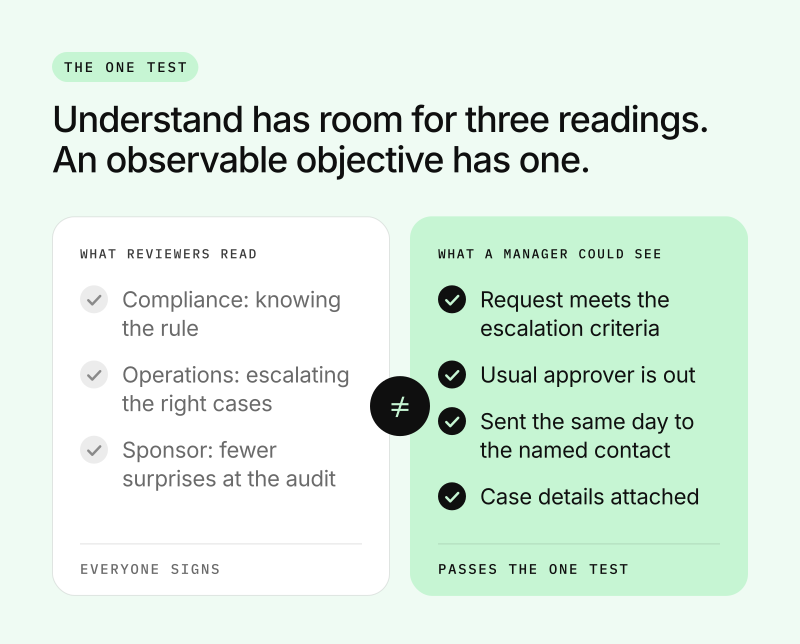
A new verb on its own won't pass. “Team leads will identify escalation cases” sounds sharper, yet nobody could watch it happen until you say which moment, which action and who would notice.
(Nobody has ever been observed understanding something. Plenty of people have been observed nodding.)
How do you rewrite “understand” into something you can observe?
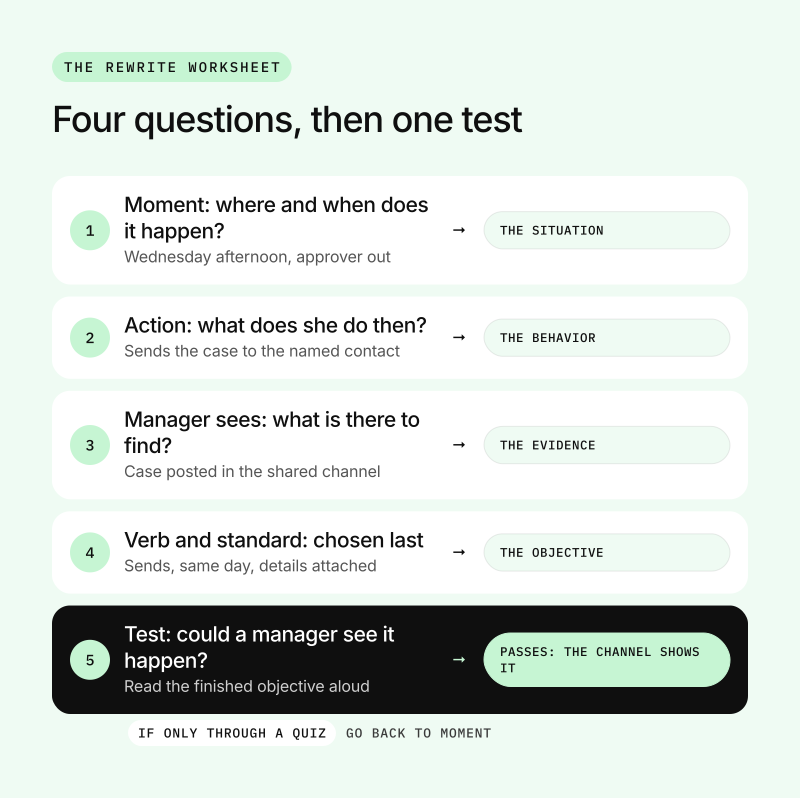
Name the moment first, then the action, then what a manager would see, and pick the verb last. The whole rewrite fits into one meeting with the sponsor.
Picture a team lead in a regional operations group on a Wednesday afternoon. A direct report brings her a request that looks like it falls under the escalation policy, and the approver she would normally ask is out until Monday.
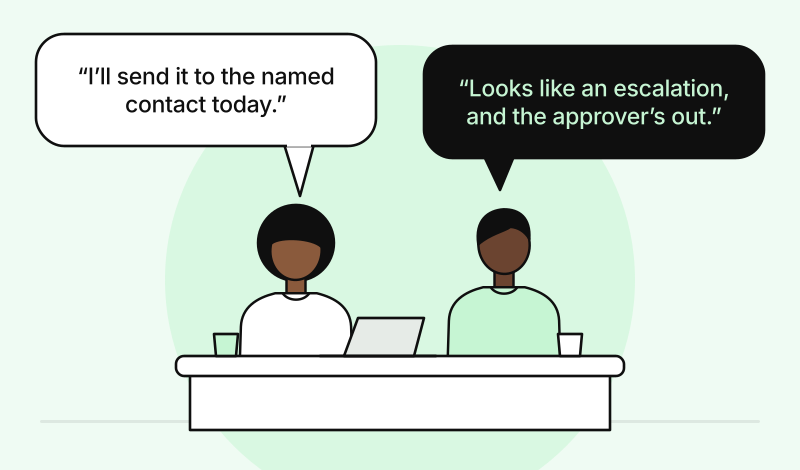
If her course covered the policy text and ended with a quiz, she can recite the definition. She still holds the request until Monday, because nothing in the course put her in the moment of deciding.
Now picture a 30-minute working session a week after kickoff. You ask one question: what would we see if she handled Wednesday well? After a minute (and a short detour into who actually owns the shared channel), the group has its answer, and it goes straight into the worksheet.
The four-question rewrite, filled in
Every detail here is hypothetical, so swap in your own moment, roles and systems.
- Moment: Where and when does it happen on the job? Wednesday afternoon at her desk, a request that meets the escalation criteria, the usual approver out.
- Action: What does she do in that moment? She recognizes the case, sends it to the named contact in the shared channel and tells her direct report what happens next.
- Manager sees: What could a manager find without a quiz? The case posted in the shared channel the same day, details attached.
- Verb and standard: Choose the verb last and attach the standard. “Sends,” the same day, to the named contact, details attached.
- Test: Read the finished objective aloud and ask whether a manager could see it happen. If the honest answer is “only through a quiz,” go back to Moment. This one passes: the shared channel shows the case, the time and the attachments.
With that line in the brief, the scenarios put her at that desk with the approver away, and when the sponsor asks what changed, you have a behavior to point to.
At this point a verb list is useful as a check. A July 2026 post on the LMS company Aquilon's blog describes Bloom's taxonomy, published in 1956 and revised in 2001, as a verb picker, and says an Apply objective needs a task or a simulation to assess. I'd class sending a live case to the right person as that kind of job, so a quiz alone can't check it.
What do you say when the sponsor still wants “understand”?
Keep the sponsor's word as the goal and add the observable line beneath it. Then ask for one working session on the moment itself, which costs a lot less than a rebuild.
“Fine, but my VP wants it worded that way, and it's mandatory regardless.” Fair enough. Governance wording sometimes has to stay exactly as written, and I wouldn't spend goodwill fighting over a verb.
- Keep the goal: Leave the sponsor's wording as the headline goal, untouched.
- Add the line: Put the observable behavior directly beneath it, in the same document.
- Ask for a session: Request one 30-minute working session before storyboarding to agree on the behavior.
A mandatory course still needs scenarios, and the behavior line tells you which ones: the desk, the missing approver, the shared channel. The quiz can stay to check recall of the rule.
If nobody in the session can name a behavior at all, stop and diagnose before you build a course. The problem may sit in the process or the tools, where no objective can reach it.
Should you show learners the objectives at all?
My view: not in the formal “By the end of this course, you will be able to” style. Keep the full objective for the design team, and tell learners the situation they are about to handle.
In a March 2023 blog post on listing learning objectives, Christy Tucker reports Will Thalheimer's research summary: “the only part of the objective that improves learning is identifying what will be learned.” In Tucker's account, extra detail such as the conditions for performance doesn't improve learning and may hinder it.
So I'd write two versions of the same objective.
- For the team: The full objective, with the moment, the action, the standard and what the manager will look for.
- For the learner: “A request lands on your desk, it meets the escalation criteria, and the approver is out. What do you do?”
How do you know the objective worked?
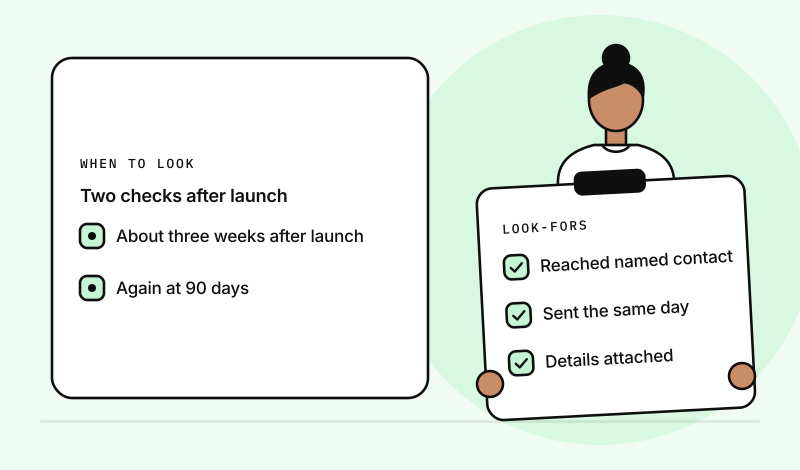
Decide before launch who will look for the behavior, what they will note and when. For the hypothetical escalation objective:
- Who looks: The team lead's manager, using the finished objective as the look-for.
- What they note: Whether the case reached the named contact the same day, with details attached.
- When: About three weeks after launch and again at 90 days. That timing is my recommendation, so adjust it to how often the moment comes up.
If you can't reach the system data, start anyway. In my view, a manager's note on one behavior needs only a shared place to write it down. The full approach to baselines and manager observation is in how to measure what changes after training.
In our Behavior Bridge method, this rewrite is the thinking behind the Behavioral Brief, the one-page brief with a measurable behavior goal that comes out of the Behavior Workshop. The Behavior Proof Plan, in the final phase, makes that behavior visible once the course is live.
So the next time “understand” arrives in a Monday email, ask the Thursday-afternoon question again, and this time the silence can end with a sentence somebody writes down. This week, run the four questions on one objective in your queue that says “understand.”
If you have a module already live whose objectives say “understand” and someone wants it refreshed, send it to us for a free diagnostic, and you'll get the three highest-impact improvements within one to two working days.
FAQ
Do performance objectives and learning objectives mean the same thing?
People use the terms loosely. My view: the label matters less than whether the sentence names an action in a moment on the job that a manager could see.
How do you rewrite the objectives of a course that already exists?
Run the four questions on each objective and drop any that no manager could ever see. Then check that the scenarios put people in the moment you named.
Which action verbs work best for learning objectives?
Verbs a manager could see or find: sends, asks, decides, records, refers. Pick one after you have named the moment and the action.




Your people already sat through the training. Now get them to actually do it.
We design learning that changes what your people do on the job. No deck. No pitch. A real conversation about your people and what you need them to do differently.