

How to Choose a Custom E-Learning Partner When Every Demo Looks Great
How to choose a custom elearning partner when every demo impresses. Ask for proof of changed behavior in writing, score it, and run a paid pilot.


Picture the week you set aside to work out how to choose a custom e-learning partner: three pitches, Monday, Wednesday and Thursday. Each deck opens with glossy course screens, a process diagram and a slide of logos. On Thursday you ask the question you asked twice already, “What did people do differently afterward?”, and for the third time the answer is about engagement.
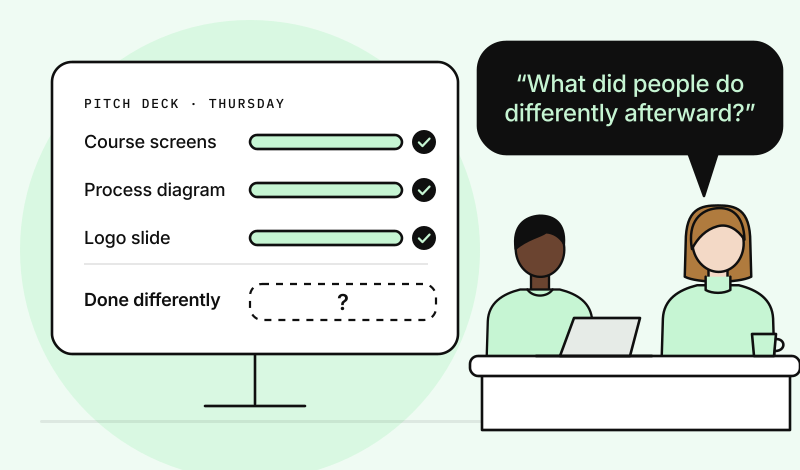
Your sponsor will ask the same thing after launch. In a July 2024 Chief Learning Officer article, Manasi Agarwal reported how stakeholders put it to L&D: “Tell me the change I will see after this intervention.” It's worth asking before anyone signs, too.
The demo can't settle it. Ask every partner for craft and proof of change, in writing, score the proof above the polish, and let a paid pilot on one real behavior decide. Here's a selection sheet you can fill in on Monday, with the evidence to request, scorecard weights and reference questions.
Key takeaways
- Polished demos show craft, which every shortlisted custom e-learning partner can supply, so the demo should not decide the contract.
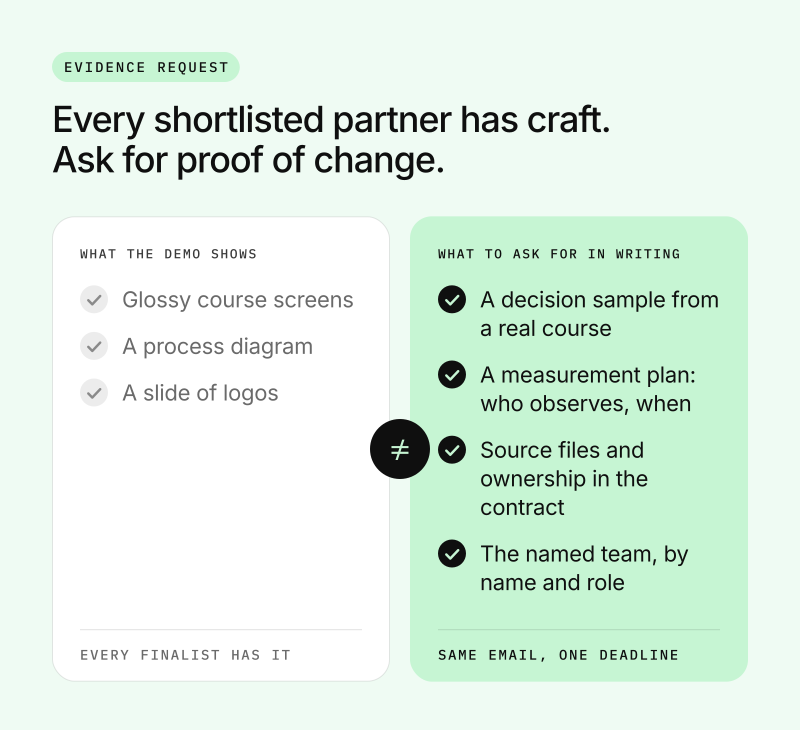
- Ask every partner for the same four pieces of evidence in writing: a sample showing a decision, a measurement plan, source-file and exit terms, and the named team.
- A weighted scorecard should give proof of changed behavior and the measurement plan more weight than visual polish or price.
- A paid pilot on one real behavior shows how a partner handles feedback, deadlines and your subject-matter experts before you commit to a multi-year contract.
- In a reference call, ask what managers saw people do differently and when anyone checked, because satisfaction tells you little the demo didn't.
Why does every demo look equally good?
Because craft is the easiest thing a custom e-learning company can show you, and every shortlisted one has it. Polished screens can't show what anyone did differently afterward, so the demo shouldn't be the round that decides.
Jennifer Bell makes a related point in a May 2026 guide published by a custom e-learning company: “The signals you need are usually in the discovery call and the proposal, not the portfolio.” I like her check for real custom work: two recent courses for two different clients should look meaningfully different.
In my view, the logo slide is the weakest evidence in any deck. A logo tells you someone signed a contract. It says nothing about what their people did the Monday after launch.
If three decks blur into one, look at the brief they were answering. A pitch answers the brief it was sent (ask to see their work and you will, reliably, see their work), so send a sharper one.
“Tell me the change I will see after this intervention.” A question stakeholders put to L&D, as reported by Manasi Agarwal in Chief Learning Officer, July 2024.
What evidence should every partner bring?
The same four things, in writing, from every partner. Send one email with one deadline, so the answers land side by side.
- Decision sample: One scenario from a real course where the learner makes a call and sees its consequence. A quiz at the end of a policy summary doesn't count.
- Measurement plan: What they would look for on the job, who observes it and when. I'd ask for a check about three weeks after launch and another at 90 days.
- Source files: The SCORM package plus the editable source files, with ownership stated in the contract.
- Named team: The people who will do the work after the pitch, by name and role.
I'd read the measurement plan first, because your sponsor will ask about it. For a model to send with your request, use the evidence plan in how to measure what changes after training.
Ownership sounds like contract housekeeping until a policy changes and the course needs a two-line edit. Without the editable files, that edit becomes a rebuild, so settle it before the pilot starts.
How do you weight a scorecard so polish doesn't win?
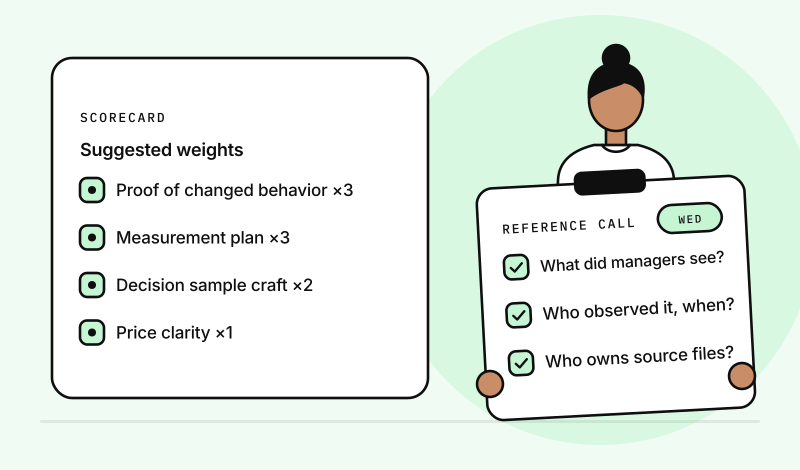
Give proof of changed behavior and the measurement plan the heaviest weights, craft the next, and price a line of its own.
- Instead of: Scoring the showreel and the logo slide.
- Try: Scoring the written evidence of changed behavior, the measurement plan and the pilot.
“Fine, but procurement needs a competitive RFP with a price comparison.” Fair, and you can give them one. In five public e-learning RFPs published between 2024 and 2026, price carried 10 to 30% of the score and never more, according to EdzLMS's August 2026 RFP guide.
That's a small, hand-picked set, mostly universities and public bodies rather than regulated enterprises, so read it as what those buyers did. In the same five, instructional design and technical solution was the heaviest bucket every time, at 20 to 50%.
10 to 30% of the score went to price in five public e-learning RFPs published between 2024 and 2026, according to EdzLMS's August 2026 RFP guide.
I'd skip any scorecard where price outweighs proof of changed behavior, because the cheapest quote on a course nobody applies turns out to be the expensive one. If procurement insists on a bigger price weight, keep proof of behavior at least level with it. For why the quotes themselves rarely line up, see why custom e-learning quotes never seem to compare.
Why should a paid pilot be the real test?
A pilot on one real behavior shows how a partner handles feedback, deadlines and your SMEs under normal working pressure, and no deck can show you that. In my view it belongs before any multi-year commitment.
Saagar Dhome's July 2026 buying guide for North American buyers, published by a custom e-learning vendor, names a scoped pilot of one module as the most valuable step in its framework and advises a paid pilot module before signing anything multi-year. That's a vendor's recommendation (no study behind it), and I agree with it.
Partners sell pilots, too. Our own 14-Day Pilot at Euvouria is $12,000 for one production-ready 30-minute Articulate Rise course around one behavior, in two focused weeks, so hold us to the same checks as anyone else.
“A paid pilot before quarter-end? I don't have the time or the budget.”
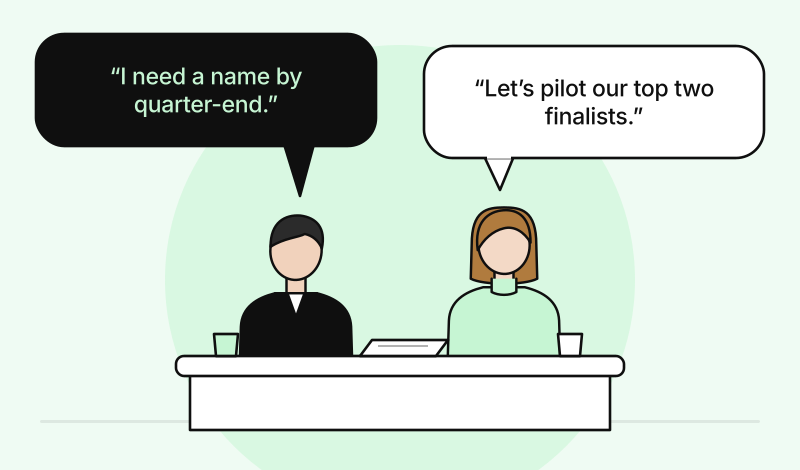
If your VP wants a name by quarter-end, I'd run the pilot with your top two finalists if the budget allows, and with one if it doesn't. Allow about a week for the evidence request, a few days to score, and the rest for one short module.
What do you ask a reference besides whether they were happy?
Ask what the client's managers saw people do differently, and when anyone checked. A reference who can only describe satisfaction has told you what the demo already did.
These are the questions I'd bring to every reference call:
- What behavior was the course meant to change?
- Who observed it, and when?
- What did the partner do when a review round slipped?
- What would you ask them to do differently?
- Who owns the source files today?
Picture a Director of Learning at a mid-size manufacturer choosing between two finalists for a course for line supervisors. The behavior fits in one sentence: supervisors record and escalate a suspected quality issue at shift handoff, on the standard form, before they leave.
It's Wednesday, a week after both pilot modules arrived, and she is on a reference call for the finalist with the most polished demo, her scorecard open beside the pilot storyboards. She asks what the reference's managers saw people do differently, and when anyone checked.
The answer is about how much learners enjoyed it and how smoothly the project ran. Then she pulls up the other finalist's pilot, where the team asked supervisors on the floor how handoff actually goes and wrote the escalation decision into the storyboard.
Without a selection sheet, she picks on the demo and the happy reference. Six months later nearly everyone is marked complete, the handoff notes still say all is well, and when her sponsor asks what the course changed, all she has is screens and a completion report.
With one, both finalists were already scored against the one-sentence behavior, and the call only confirms or contradicts each plan. She picks the partner who named what supervisors would be seen doing, who would watch and when, and can tell her sponsor what she'll report at about three weeks and at 90 days.
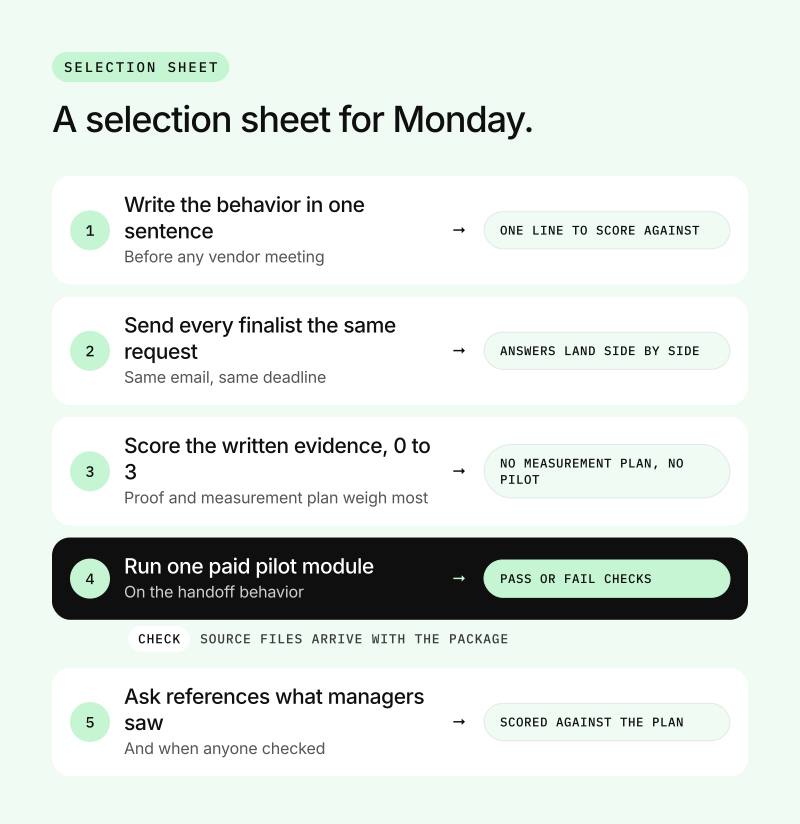
A selection sheet to fill in on Monday
Here is that sheet, filled in for the shift-handoff course. Every detail is hypothetical, so swap in your own behavior, roles and weights.
- Behavior: One sentence, written before any vendor meeting: line supervisors record and escalate a suspected quality issue at shift handoff, on the standard form, before they leave. If a stakeholder needs convincing, start with a one-page training brief.
- Evidence request: The same email to every finalist with the same deadline, asking for a decision sample, a measurement plan with checks at about three weeks and 90 days, source-file and exit terms in writing (SCORM plus editable source files), and the named team.
- Scorecard: Score each finalist from 0 to 3 on each line, from the written evidence only. Suggested weights, to adjust: proof of changed behavior ×3, measurement plan ×3, decision-sample craft ×2, ownership and LMS delivery ×2, price clarity ×1. One gate: no measurement plan, no pilot.
- Pilot test: One paid module on the handoff behavior, with pass or fail checks. The storyboard shows the escalation decision, the team interviewed supervisors on the floor, reviews stayed inside one consolidated round per stage, and the editable source files arrived with the package.
- Reference question: “What did your managers see people do differently, and when did anyone check?” Then: “What would you ask them to do differently?” Score both answers against the measurement plan that finalist gave you.
In our Behavior Bridge method, that first line is what the Behavioral Brief produces: one page with a measurable behavior goal, which gives you the same sentence to score every partner against.
The next Thursday pitch goes differently: you open with one sentence about the behavior, every team has had the same evidence request, and the glossy screens become one line on a scorecard. This week, write that sentence and send the same request to all three teams.
“We evaluated six instructional design partners. Most had either strong craft or measurable outcomes, never both.” That's how one client described the search (Head of Talent Development, Global Financial Services Group).
If a current or former partner built a module you already run and you want to see where it loses the behavior, send it to us for a free diagnostic: one existing module in, the three highest-impact improvements back within one to two working days.
FAQ
What if a vendor can't share client results because of confidentiality?
Ask for an anonymized description of one behavior a course targeted, who observed it and when, plus a reference call arranged through the client. A sentence about a behavior and a check date is easy to anonymize. If a partner can't describe any measurement plan at all, treat that as a signal about how they work, though it doesn't prove poor results.
What should I own at the end of the project?
The SCORM package and the editable source files, with ownership written into the contract before the pilot starts.
Should the pilot come before or after the scoring?
After, as the final round for your top finalist or two. I'd plan for one short module over about two to four weeks, with the pass or fail checks agreed in writing before it starts.




Your people already sat through the training. Now get them to actually do it.
We design learning that changes what your people do on the job. No deck. No pitch. A real conversation about your people and what you need them to do differently.