

A Training Brief Template That Settles Arguments Before the Build
Get a one-page training brief template that names the behavior, the moment and what is out of scope, so you settle the argument before anyone builds.


Picture a Friday at 5:40 p.m., when a chat message from operations lands: “We need a 30-minute module on the new escalation process, with a quiz. Can you have it by March?” By the time you read it, the sender's green dot has gone gray.

If you build training for a living, you know that message. The two usual replies both feel productive at 5:45 p.m.: start storyboarding over the weekend, or send back an intake questionnaire that sits unanswered until February. Neither one tells you what anyone should do differently.
The better reply is a training brief template that fits on one page, filled in with the requester in a short working session: the behavior, the moment it happens, who performs it, what gets in the way, the signs of success and what is out of scope. Here it is, worked through for this exact request, along with the arguments it settles while they are still cheap.
Key takeaways
- A request that arrives as a course title fixes the format and the deadline, and it leaves the argument about what should change until that argument is expensive.
- A training brief template needs only six lines: the behavior, the moment, who performs it, what gets in the way, the signs of success and what is out of scope.
- The out-of-scope and signs-of-success lines settle the most arguments early, because the requester agrees to them before anything is built.
- Even when the requester insists on the course, one short working session lets you build it around a behavior someone can see, checked against a baseline about three weeks after launch and again at 90 days.
Why is a course title such a weak brief?
Because it fixes the format and the date and pushes every real disagreement into the build: what the course should do, what goes in it, how anyone will know it worked. The build is where changing your mind costs the most.
Look at the Friday message again. The 30 minutes and the quiz are guesses about format, made before anyone has said what should change (and in fairness to the requester, a course with a test at the end may be the only picture of learning they have). Set it next to a hypothetical rewrite of the same request.
- Instead of: “A 30-minute module on the new escalation process, with a quiz, by March.”
- Try: “When a client message meets an escalation trigger, the specialist opens the ticket before replying, and the module lets them practice that decision.”

JD Dillon, Chief Learning Officer at the learning-technology vendor Axonify, described that picture in a 2024 interview with TechR Series: “Most of our stakeholders went to school. They believe education is a place-and-time activity where people complete a course and take a test at the end to make sure they learned.”
It is one practitioner's view, but I'd bet you recognize the request it produces.
Stuart Harris makes a related point in a June 2026 article on writing briefs for training vendors. His example of a brief that tells a vendor almost nothing is “We need a leadership workshop”, and he names describing what you want to do, rather than what you need to change, as a mistake.
He is writing about briefs sent to outside vendors. Applying the same logic to the requests your own team receives is my extension, and I think it holds.
What happens in the working session where the brief gets written?
You write the brief together, live, with the requester and one person who sees the work happen. The people in the room end up arguing about one behavior, and they settle it before anyone storyboards.
Picture the Tuesday after: a video call, a shared document with six empty lines, you, the head of client operations who sent the request, and a team lead from the client-service desk. The head of operations asks for an explanation of the new process, with a quiz.
You ask the team lead one question: what does a specialist do today when a client message looks like an escalation? Usually they answer it themselves, the team lead says, because the first-reply clock is running and opening a ticket feels like losing time.

From there it moves fast. The group writes the behavior line (the specialist opens the escalation ticket before replying), fills in the other five and records the reply-time target as owned by operations, out of scope for the course.
- Without the brief: The first draft arrives in week six, the requester wants the quiz to cover the whole policy, a compliance partner asks about the policy rewrite, and the March date holds while the scope grows.
- With the brief: The behavior, the moment and the people are agreed on Tuesday, the reply-time target has an owner outside the course, and every disagreement happens before a storyboard exists.
That clock is a process question, the kind you find when a request turns out not to be a training problem, so it goes back to its owner. I'd skip the long intake form and start with this conversation: a form lets the requester answer alone, and the useful friction comes from answering together.
What goes in a training brief template that fits on one page?
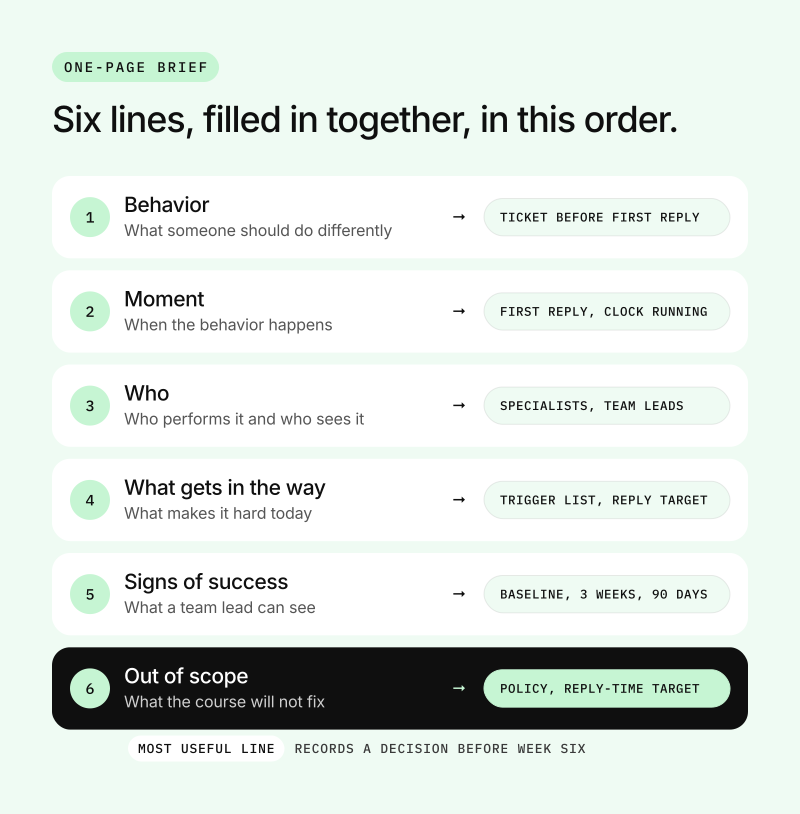
Six lines, filled in with the requester in this order, shown here for Tuesday's escalation request. Every detail is hypothetical, so swap in your own behavior, roles and systems. If the first line comes out vague, the test for writing the behavior line so someone could see it will tighten it.
- Behavior: When a client message meets an escalation trigger, the specialist opens an escalation ticket before replying.
- Moment: The first reply to a flagged client message, during a busy shift with the reply clock running.
- Who: First-line specialists on the client-service desk perform it; their team leads see it in the weekly ticket review.
- What gets in the way: The trigger list lives on an intranet page, the reply-time target rewards fast answers, and specialists aren't sure whether a borderline message counts.
- Signs of success: Team leads sampling tickets see the escalation ticket opened before the first reply. Take a baseline sample the week before launch, then look about three weeks after launch and again at 90 days (my recommendation).
- Out of scope: Rewriting the escalation policy, which stays with the policy owner; changing the reply-time target, which operations owns; training the receiving queue, which nobody has requested.
In our Behavior Bridge method, this job belongs to phase 1, Define the Behavior: a Behavior Workshop turns a vague request into one behavior people must perform, written up as a one-page Behavioral Brief with a measurable behavior goal.
The signs-of-success line is where someone says, “I can't get the data.” My view is that the first look rarely needs a system. Pick something a team lead can see in existing work, count it by hand, and follow the steps for measuring what changes after training.
In my view, the out-of-scope line is the most useful line on the page. It records a decision someone would otherwise reopen in week six, probably in a meeting called “quick sync on the module.”
Which stakeholder arguments does the page settle early?
Three of them: format, scope and success. I'd say each is cheap to settle while the page is blank and expensive once a storyboard exists.
- Format: “Can't we just do slides and a quiz?” The behavior and moment lines answer it, because the format follows from what people must do and when.
- Scope: “While we're at it, add the whole policy.” Point to the out-of-scope line, where everything left off has a named owner.
- Success: “How will we know it worked?” The signs-of-success line already says, with a date to look.
Disagreements surface while they are still small. If the requester and the team lead can't agree on the behavior, you have learned that for the price of one call, before anyone has built a screen.
What if your VP wants the course by Q3 anyway?
“Fine, but my VP wants the course by Q3.” Then build it, and ask for one working session first so the course has a behavior someone can see at its center. In my view, half an hour costs less than rewriting a quiz in week six.

“It's mandatory regardless.” Then the requirement decides that a course exists, and the brief decides what it has to change. If the data is the worry, the hand-counted ticket sample works here too: a baseline before launch, a first look about three weeks after, a second at 90 days.
The next time a message lands at 5:40 on a Friday, reply on Monday with six lines and an invitation to a short call, so the first argument happens on that call, weeks before a storyboard exists.
This week, open the last course request in your inbox and write only the behavior line and the moment line. If you can't, that gap is your finding, and your first question for the requester.
If you have a module that started life as a message like that one and suspect the behavior got lost on the way, send it to us for a free diagnostic, and we'll send back the three highest-impact improvements within one to two working days.
FAQ
What if the requester and the SME disagree about the behavior?
Treat the disagreement as the finding. Ask each of them to describe what a good performance looks like at the exact moment it happens, and settle it before any build starts.
Who should be in the working session?
I'd keep it to the requester, you and one person who sees the work every day, such as a team lead. Each extra person, I find, pulls the session toward a review.
What is the difference between a training brief and a learning project charter?
As I see it, a charter records scope, roles, dates and budget, and the brief records the change: the behavior, the moment and the signs of success. I'd keep both, brief first, so the charter plans a project that already knows what it has to change.



Your people already sat through the training. Now get them to actually do it.
We design learning that changes what your people do on the job. No deck. No pitch. A real conversation about your people and what you need them to do differently.