

Does Leadership Training Transfer Survive the First Monday Back?
Leadership training transfer is decided in the first real attempt back at work. Plan that one conversation, from rehearsal to a 90-day team check.


Picture a leadership program that closes on Thursday to strong ratings and a round of applause for the facilitator. On Monday, one participant opens her team meeting with the coaching question from day two, and her director cuts in: “Let's just do it the usual way.” She nods, moves on, and never tries it again.

If you have signed off a program like that, you know the pause when your CPO asks about leadership training transfer. The ratings were real, and they say nothing about what her team saw on Monday. (No evaluation form asks about the director.)
In my view, leadership training transfer is decided in that first real attempt. So design the attempt: pick the conversation managers avoid, rehearse it against real pushback, give her director one sentence, and prompt her afterward. You'll get a one-page plan you can wrap around a program you already run.
Key takeaways
- Strong evaluations after a leadership program do not show that anyone applies what they learned; a 2024 framework article calls transfer neither automatic nor certain.
- In my view, leadership training transfer is decided in the first real attempt back at work, and the first person to react to that attempt is often the participant's own manager.
- A first attempt has a better chance when three things surround it: practice against realistic pushback, one sentence from the participant's own manager, and prompts in the weeks after.
- The people on the receiving end can tell you whether behavior changed, so ask the participant's team about one specific behavior at about 90 days.
Why does leadership training transfer fail after a well-rated program?
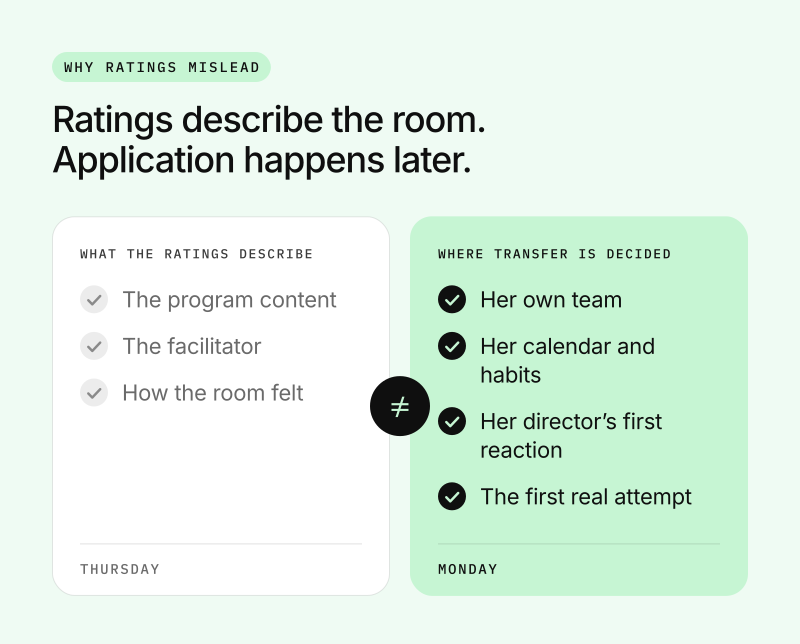
Because the ratings describe the room, and the application happens later, inside her own team, calendar and habits. In the meeting above, the first reaction came from someone who was never in the room.
In a 2024 framework article drawing on four literature reviews, Jaason M Geerts of the Canadian College of Health Leaders writes that despite extensive global investment and typically favorable program evaluations, training transfer and its outcomes “are not automatic or certain.”
Julie Winkle Giulioni, a learning and development professional, recalls an early-career project from about 30 years before her Summer 2024 column in Training Industry. She traced the lackluster results to the managers of the account associates she had trained, managers she had ignored. Looking back, she put it plainly: “It didn’t matter how wonderful the learning was if leaders weren’t prepared to support it.”
In my view, that is still the design gap: the program trains the participant and leaves out the one person whose reaction decides the first attempt. Her director had no warning that a coaching question was coming, so he reached for the agenda he knew.
“It didn’t matter how wonderful the learning was if leaders weren’t prepared to support it.” Julie Winkle Giulioni, learning and development professional, recalling an early-career project in Training Industry, Summer 2024
Which conversation should a leadership program actually train?
The one your managers keep putting off, written so that a colleague could watch it happen. Written that way, it gives her a first line to try on Monday.
Good candidates are small and a little uncomfortable: feedback on a pattern someone has slipped into, a coaching question in a team meeting, a handover conversation with a long-serving colleague. My test is whether someone could watch it on a Tuesday and say whether it happened.
If you want a hand with the wording, the same test runs through writing a behavior someone can actually see.
- Instead of: A module on coaching skills with a quiz at the end.
- Try: One coaching question asked in this week's team meeting, then a follow-up one-on-one a colleague could watch.
I'd skip a second topic until the first conversation has happened once, back at work, with real people. Every extra module competes for the same crowded Monday, and the conversation she avoided is still waiting for her.
What does a rehearsed first attempt look like back at the plant?
A short, specific conversation she has already practiced against realistic pushback, so the first brush-off doesn't end it.
Picture a quality lead at a manufacturing plant, a few days out of a leadership program. One long-serving shift supervisor's handover notes have been thin for weeks. She has avoided raising it, because he has been on the floor longer than she has and there is never a quiet slot.
Without a plan, she mentions handover notes in a group email. He reads it as general advice, nothing changes, and she decides the program didn't fit her plant. Nobody can tell whether the program failed or the conversation never happened.
With a plan, her phone shows the opening line she wrote in the last session on Monday morning. Her director, asked in one sentence to check in on Friday, has put “handover conversation?” on their agenda. On Tuesday she books a one-on-one, names one specific shift note, asks how he sees it, and they agree on one change and a date to look again.
She got there partly because she had heard the hard replies before. In the last session, a colleague played the supervisor and tried three invented lines on her:
- The brush-off: “We've always done it this way.” She practiced acknowledging it and coming back to the one shift note.
- The deadline: “I don't have time for this today.” She practiced offering a time later in the week before letting it drop.
- The doubt: “Is this really what that program meant?” She practiced saying, in her own words, what she needs from the next handover.

Why put so much into the first try? In a 2025 study in the International Journal of Training and Development, Charlotte Sophie Diekmann and Alexander Pundt surveyed 65 leaders weekly for five weeks after various leadership trainings. Leaders' satisfaction with their transfer experiences in one week significantly predicted their transfer behavior the next week, after accounting for the week before.
It is a small sample, and the leaders reported on themselves, so I treat it as a strong hint about where to aim. The rehearsal is my recommendation; no study cited here tested role-play itself.
What goes on a one-page plan for the first attempt?
Six lines per participant: the conversation, what to look for, the pushback to expect, the sentence her own manager will say, when she gets prompted, and how her team gets asked later.
“Fine, but the program already exists and is booked for the whole cohort.” Good, keep it. The plan wraps around the program you have, and I'd fill it in during the last session, while the material is fresh and the facilitator can help with wording.
Here it is for the quality lead. Every detail is hypothetical, so swap in your own conversation, people and dates.
- Conversation: Feedback on thin handover notes to one long-serving shift supervisor, in a one-on-one this week.
- Look-for: She names one specific shift note, asks how he sees it, and they agree on one change and a date to look again.
- Pushback: “We've always done it this way” and “I don't have time for this today,” practiced in the last session with a colleague playing the supervisor.
- Sponsor sentence: Given to her director before the program ends: “She will try a feedback conversation this week; please ask her on Friday how it went.”
- Prompt: A message with her own opening line on the Monday after, a second one mid-week, then one short weekly prompt for the first five weeks.
- Team check: At about 90 days, two or three questions to the people who report to her, such as “In the last month, has your manager talked with you about a specific example of your work?” and “Did it help?” Record the answers next to the behavior and the date, with no target number.
“Her director has no time for anything extra.” He doesn't need any: the sponsor sentence asks for one question in a Friday check-in he was going to have anyway. I'd still say it to him in person or on a short call, and keep it to the one sentence.
How do you find out what changed three months later?
Ask her team, not her. At about 90 days, put two or three questions about the one behavior to the people on the receiving end.
That is how Jørgen Skovhus Haunstrup and Ulrich Thy Jensen of Aarhus University judged their 2024 field experiment. They worked with 226 Danish public managers and their 4,442 employees, paired leadership training with just-in-time implementation nudges, and drew on survey responses from 1,889 employees collected before and after. Employees perceived their managers as showing more transformational leadership behaviors after the intervention.
Danish government agencies are not your plant or your bank, and the finding is about what employees perceived. The method travels well, though, and a short survey is all it needs.
“I can't get the data on what changed in their teams.” You don't need system access for this. I'd send the same questions once before the program as a rough baseline, and again at about 90 days, so you have something honest to compare.
When your CPO wants evidence, report four things:
- Behavior: the one conversation the program trained.
- First attempt: the date it was first tried.
- Baseline: what the team said before.
- At 90 days: what the team said after.

It follows the same logic as measuring what changes after training, and it holds up better at a review than another satisfaction score.
In our Behavior Bridge method, the last phase is Make the Behavior Visible, and its deliverable is the Behavior Proof Plan. The team check is a small version of that job.
One client described what it looks like when managers do start having those conversations (Chief People Officer, International Retail Brand): “The quarter our redesigned program launched, manager-led coaching conversations rose 63%, the highest we had ever measured. Before, managers completed the training and changed nothing. Now they are having the conversations the business actually needed.”
Now run that Monday meeting again. Her director heard one sentence about the attempt in advance, she has already rehearsed an answer to “the usual way,” and her phone reminded her of the opening line. The coaching question gets a second try, and in three months you can ask her team what they saw.
This week, pick one participant in your next cohort and fill in the first three lines of the plan with her.
If your leadership program is already running and you want a second pair of eyes on it before the next cohort, send us one existing module for a free diagnostic, and we'll return its three highest-impact improvements within one to two working days.
FAQ
Is this a coaching issue or a training issue?
It can be both. If the participant's own manager rewards the old way, another program won't fix it, so check what happens in the first attempt before you commission more training. The five questions for deciding whether it's a coaching issue or a training issue help you sort it out.
How long after a leadership program should you check whether anything changed?
I'd prompt weekly for the first five weeks, then run a short team check at about 90 days. The five weeks borrow from one small study's weekly design, so treat them as a starting point.
What if the participant's manager didn't attend the program?
Then the sponsor sentence matters even more. Give that manager one sentence about the attempt and one question to ask on Friday, and leave it there.


Your people already sat through the training. Now get them to actually do it.
We design learning that changes what your people do on the job. No deck. No pitch. A real conversation about your people and what you need them to do differently.