

Performance Review Training for Managers Who Dread the Conversation
Performance review training for managers should rehearse the opening, the evidence, the reaction and the next step out loud, not just teach the form.


Picture a manager on the Sunday evening before review week, the rating guide open on the kitchen table for the third time. She could recite the scale in her sleep. What she hasn't worked out is what to say when a solid performer hears “meets expectations” and goes quiet.
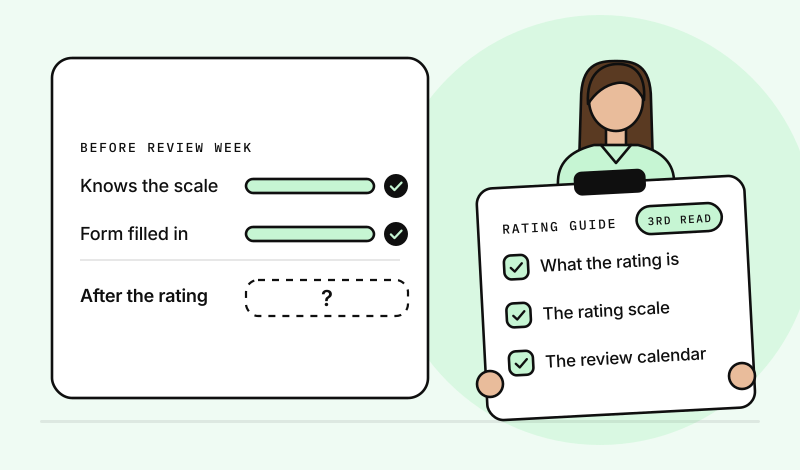
If you have sat in the debrief after review season, you know a conversation can go sideways even when every form was filled in correctly. When your performance review training for managers covers the form, the scale and the calendar, it prepares them for the paperwork. Nobody rehearses the minute after the rating is said out loud.
In my view, managers dread it because the form is the only part anyone has let them practice. So rehearse the four moments out loud, with a peer, before any rating is at stake: the opening, the evidence, the reaction and the next step. You'll get a filled-in rehearsal card and a 45-minute session you can run before reviews open.
Key takeaways
- Managers can know the rating form and still freeze in the review conversation, because nobody has rehearsed what happens once the employee reacts.
- Performance review training for managers works best when it rehearses four moments out loud: the opening, the evidence, the reaction and the next step.
- A 2023 teaching article in Management Teaching Review says feedback is most effective as a dialogue rather than a monologue.
- One 45-minute rehearsal in groups of three, about two weeks before review conversations start, fits practice inside a busy season.
- You can check whether it worked by what managers did and what employees could repeat back afterward.
Why do managers who know the rating form still dread the conversation?
Because the form covers the decision and the conversation covers the reaction, and most programs only teach the decision. The guide explains what the rating is and stops there, one second before the employee hears it.
As of October 2026, HR Leader's summary of Highwire's report “Who's Managing Whom” says 82.5% of organizations tie performance outcomes to merit increases, yet only 19.2% make training mandatory for reviewing and 17.9% for giving feedback. Highwire is a performance coaching program, so this is vendor research reported secondhand, and the article doesn't say which sample the organization figures come from.
19.2% of organizations make training mandatory for reviewing, according to HR Leader's October 2026 summary of Highwire's vendor-run report.
The conversation is a skill, and a hard one. In a 2023 teaching article in Management Teaching Review, Natasha J. Johnson of Tennessee State University writes: “Feedback is most effective when it is constructive and when it involves a dialogue rather than a monologue, but people often struggle with this skill.” Her literature review adds, citing studies from 1979 to 2003, that managers may dilute negative feedback to avoid conflict.
In a November 2024 McKinsey Talks Talent podcast, Brooke Weddle said only about 20% of respondents to McKinsey's global survey who had no development conversations felt motivated by their company's performance management, against 77% of those who received ongoing feedback in development conversations. Those figures describe an association with motivation, and they come from development conversations, so read them as context for the annual review.
In my view, a rating-scale refresher shouldn't be the main event of manager preparation, because the scale is the part managers already know. Give it 10 minutes and spend the rest on what they will say.
What does a manager have to get right once the conversation starts?
Four moments: the opening, the evidence, the reaction and the next step. A peer can watch each one and check it off, which is what makes it trainable.
- Instead of: a session on the form, the scale and the review calendar.
- Try: rehearsing the opening, the evidence, the reaction and the next step out loud with a peer.
- Opening: The rating and the reason, said in the first minute, so nobody sits through small talk waiting for the verdict.
- Evidence: Two things the manager saw, each with a date and a situation. A general impression of the last three weeks won't hold up.
- Reaction: What the manager does with the silence or the pushback. This is where ratings get softened.
- Next step: One behavior to keep or change, one check-in date and one person who will see it.
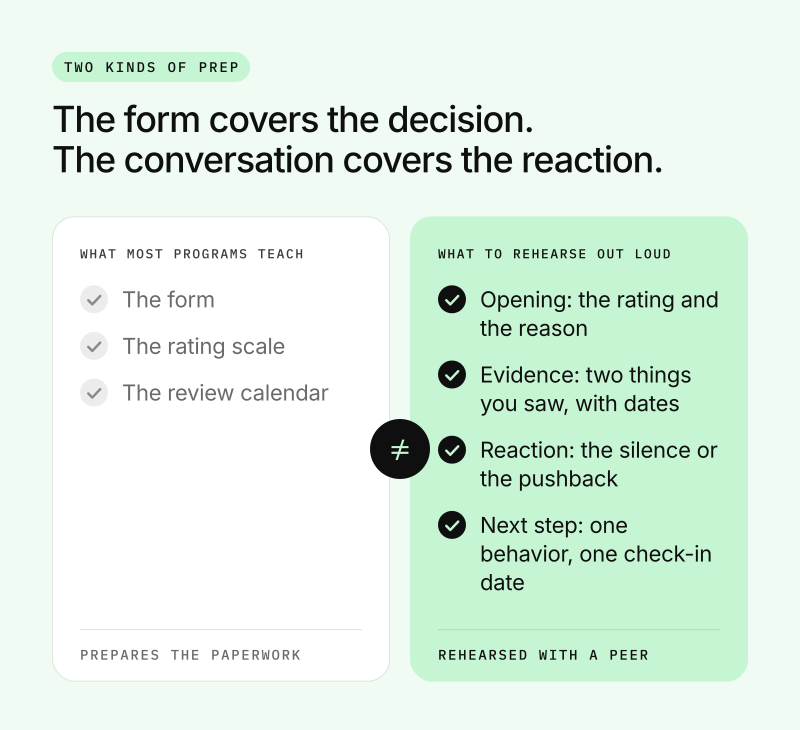
We put the rating first because, in my view, anything said before the verdict gets heard as a warm-up. Dated, observed examples are a design choice: they give both people specific moments to discuss.
I'd rehearse the reaction first. Nobody can prepare for that moment alone at a kitchen table, because it depends on what the other person does.
What does a rehearsal look like when an employee pushes back on the rating?
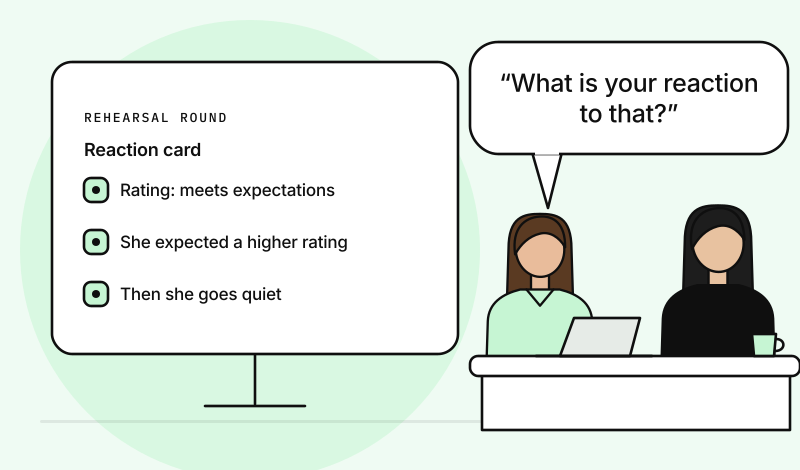
A peer plays the employee from a short reaction card, the manager runs the four moments out loud, and an observer checks what was said against the card. A round takes minutes, and the useful part is the second attempt at the reaction.
Picture a manager who runs a regulatory affairs team, on the Thursday before review conversations open. She sits in a small meeting room with two peer managers and one printed reaction card, and has to tell a reliable team member that this year's rating is “meets expectations.” The peer reads from the card (she expected a higher rating) and then goes quiet.
On the first attempt, the manager fills the silence. She says the scale is strict this year, calls the rating “basically” higher and promises to look at it again. The observer writes down that promise, because she can't keep it, and a real team member would leave not knowing what the rating means.
On the second attempt, she says the rating and the reason in the first minute and gives two things she saw, with dates. When the quiet comes she waits, asks one open question, listens, restates the rating without defending it and agrees on one next step. (The rating guide she read three times on Sunday never came up.)
The four-moment rehearsal card, filled in
Every detail is hypothetical, so swap in your own roles, examples and dates.
- Opening: “Your rating this year is meets expectations. Let me walk you through how I got there.” The observer checks that the rating came before any small talk or softening.
- Evidence: Two things she saw: the submission handoff to the audit team in March and the reply to a health authority question in June. The observer checks that she saw both herself.
- Reaction: The peer reads silence, or “I expected a higher rating.” The manager names the pause, asks “What is your reaction to that?” and waits. The observer checks that she neither changed nor defended the rating.
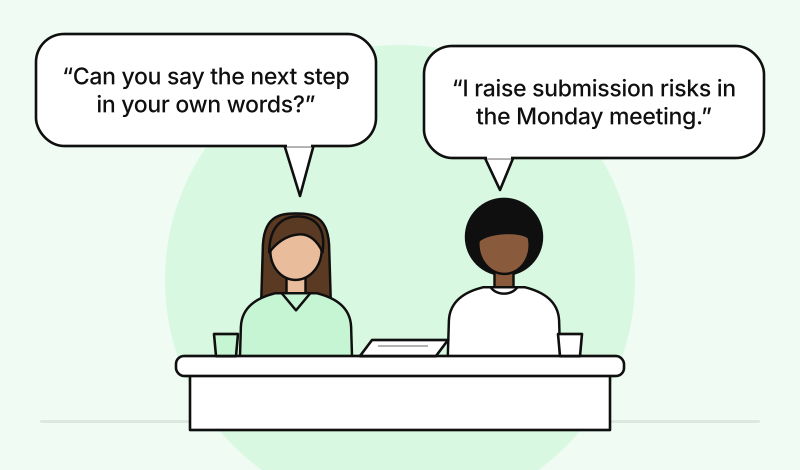
- Next step: Raise submission risks in the Monday team meeting, check in during the first week of February, with the manager watching for it there. The observer asks the peer to say it back in her own words.
- Debrief: The observer names one sentence that worked and one to rewrite. The manager re-runs only the reaction, then the three swap roles.
Highwire's practice data is context only, and none of it comes from review conversations. In an October 2026 article, Jonathan H. Westover reports Highwire's August 2026 survey of 1,034 US full-time corporate professionals, from the same vendor as the HR Leader piece. Among workers who had been offered practice for high-stakes situations, 85% said it improved their performance (a self-report), and 50% of managers against 32% of employees said they get to practice before their performance counts.
If you later want digital practice, the reaction cards can become scenarios that teach decisions.
How do you fit rehearsal into review season without pulling managers off the floor?
Run one 45-minute session in groups of three, about two weeks before review conversations start, plus one short follow-up after the first real conversation. The form, the calendar and the calibration process stay exactly as they are.
“Fine, but my managers have no time in review season.” Fair enough. That is why I'd skip the full-day workshop: managers are already stretched, and a day away in December mostly teaches them to answer email under the table.
- Rounds: Three rounds of 10 minutes, so everyone plays manager, employee and observer once.
- Debrief: 15 minutes on the reaction moment, with one rewritten sentence per person.
- Follow-up: 15 minutes within a week of each manager's first real conversation, to re-run the reaction with a real example.
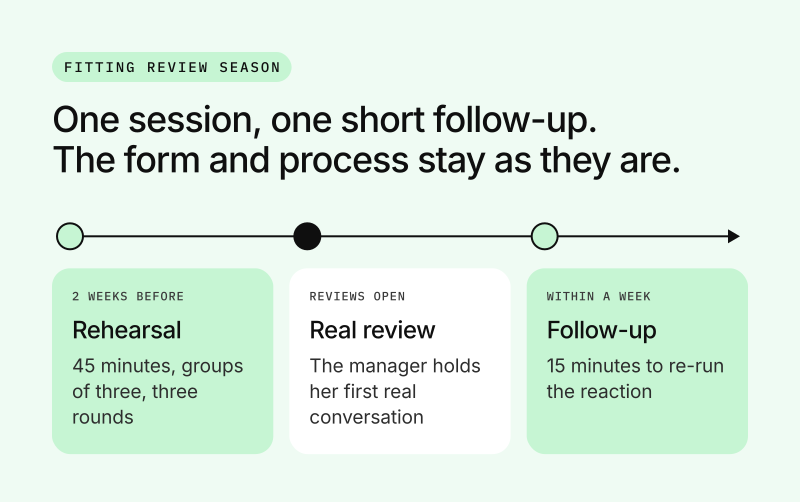
“The form and the process are set by HR, and the reviews are mandatory anyway.” Good, because the rehearsal changes none of that. It sits around the form and prepares the conversation that follows the rating.
I think practice two weeks out works for the same reason leadership training transfer happens on Monday: people need to practice a behavior close to where they will use it.
How will you know the conversations actually changed?
Look at what managers did and what employees can repeat back. Form completion and the spread of ratings tell you the process ran, not whether the conversations changed.
“How much evidence is enough?” For a first review season, I'd settle for three signs, checked about two weeks after the first round of conversations and again at 90 days. These signs are hypothetical, so adapt them.
- The manager opened with the rating and the reason.
- The employee could restate the next step in their own words.
- The manager's notes show dated examples the manager saw firsthand.
If the data is hard to reach, the observer checklists from the rehearsal are your baseline, and a two-line manager self-note after each conversation covers the rest. For the full approach, see how to measure what changes after training.
In our Behavior Bridge method, the second phase, Map the Obstacles, produces a Behavior Map, the course blueprint. The reaction step on the card is a small version of it: it names the pressure and missing confidence that make one moment hard, then builds practice around that moment.
Next Sunday the manager at the kitchen table may still reread the guide, but now she also knows her first sentence, the two things she saw and what she will do with the quiet. This week, write reaction cards for the two hardest conversations in your organization and run one round with three managers.
If your managers already have a module on the review process that covers the form, the scale and the calendar, send it to us for a free diagnostic, and we will send you the three highest-impact improvements within one to two working days.
FAQ
Can managers use AI to write review feedback?
Whether managers may draft reviews with AI is a question for your own HR policy, so this is a training-design answer only. I'd point AI at the rehearsal: let managers practice the reaction moment with it beforehand, because the conversation still depends on the manager's own judgment of the year.
What if our rating form and calibration process can't change?
They don't have to. The rehearsal teaches the conversation that follows the rating, so it works inside whatever process HR has set.
How do we know managers are ready before reviews start?
Use the observer checklist from the rehearsal: did the rating come first, were the examples observed, did the manager hold the pause, and could the employee restate the next step? Use it as a readiness check; nobody gets scored on it.




Your people already sat through the training. Now get them to actually do it.
We design learning that changes what your people do on the job. No deck. No pitch. A real conversation about your people and what you need them to do differently.