

Your Business Case for Training Needs One Behavior, Not a Module List
Build a business case for training from one observable behavior, what it costs today and the smallest test that could prove it. A one-page case to fill in.


“Tell me the change I will see after this intervention.” That is the question stakeholders put to L&D, as Manasi Agarwal reported in a July 2024 Chief Learning Officer article. Now picture your proposal going to the steering committee on Thursday: it lists modules, seat time and a launch date, and not one change anyone could observe.

If you have been in that room, you know the pause, and how small the launch date suddenly looks on the slide. The committee wanted a business case for training, and a list of modules only describes what L&D will deliver.
Build the case from one observable behavior instead: what that behavior costs today, a conservative range for how much it could change, what you will measure and when, and the smallest test that could prove it. You'll get a one-page case to fill in for the proposal already on your desk, and a way to talk about money without promising an ROI you can't defend.
Key takeaways
- A business case for training is easier to approve when it rests on one observable behavior instead of a list of modules, seat time and a launch date.
- Price what the behavior costs today, including participant and manager time, before you price the course.
- Give finance a conservative range with labeled assumptions, because a first estimate can shrink a great deal once you count only the people whose behavior actually changed.
- Ask for the smallest test: one team, one behavior, a baseline, and checks about three weeks after launch and again at 90 days.
- The cost of doing nothing belongs on the page, written as today's cost multiplied by the time until the next review.
What are leaders really asking when they want to see the change?
They want a behavior someone could watch happen and a cost they can weigh against yours. Modules and seat time give them neither.
I'd skip opening with satisfaction scores or hours delivered. They describe the course, and the committee is being asked to pay for the change. (The launch date is the one line everyone can verify, and the one nobody asked about.)
- Instead of: A proposal that lists modules, seat time and a launch date.
- Try: A one-page case that names one behavior, what it costs today, a range for the change and the check you will run.

Which one behavior should the business case be built on?
Pick a behavior that happens in one specific moment and whose cost already shows up somewhere in the business.
The order of work comes from a June 2026 guide by Justin Smith-Essex, Founder & Group CEO of the training provider emerging-u. Paraphrased, his sequence is to define the problem in work terms, link it to the behavior that could influence it, then compare the feasible alternatives, since training may not be the answer.
I'd start with the behavior whose cost somebody already complains about in meetings. People who complain about a cost usually know where the evidence sits, so you get a head start on the baseline.
Before you commit to it, run three checks:
- One sentence: You can state the behavior without an “and” holding two behaviors together.
- One moment: It happens in a conversation, a decision or a handoff you could point to on a calendar.
- Visible to others: Someone outside L&D could see it happen, or see the trace it leaves.
If the comparison of alternatives turns up a slow tool or an incentive pulling the other way, put that in the case too. In my view, a proposal that admits a course is one option among several reads as more credible, and it keeps you from funding a fix for the wrong problem.
How do you price the cost today when the data sits in other systems?
Use a labeled estimate and name the person who owns each number. A rough baseline you can source beats a precise one you can't.
“Fine, but I can't get the numbers. Operations owns them.”
You're in good company. On a 2024 Training Industry podcast episode on the ISO guidelines for L&D metrics, Tom Whelan, director of corporate research at Training Industry, described a refrain he hears from learning leaders: “I know it exists, I just can't get to it.”
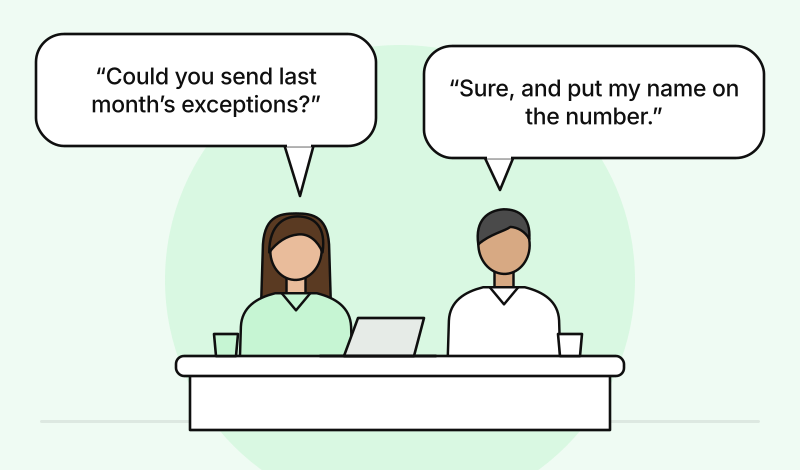
So skip the dashboard request and ask the data owner for one sample, such as last month's exceptions or a week of call reviews. Once the owner's name sits next to the number, you have an ally when finance asks where it came from.
The emerging-u guide counts the full cost, past the delivery fee to participant and manager time:
- Seat time: hours of participants away from the work, priced with your own loaded rate.
- Manager time: the time managers spend preparing, coaching and observing.
- Rework today: the effort the missing behavior already costs, from one owner's sample.
- Risk exposure: described in words and tied to a named owner, and left unpriced unless you have a source.
The cost of doing nothing goes on the same page: today's cost multiplied by the months until the next budget review, with every figure labeled as your assumption. If you are already planning your L&D budget for the day finance asks what last year bought, this line answers that question before anyone asks it.
How conservative should your estimate of change be?
Conservative enough that you could defend the low end to a skeptical finance partner. Give a range, and write the assumption next to each end.
Smith-Essex recommends the same in his guide: estimate benefits as a range with transparent assumptions, and keep claims proportionate. One published case shows why leaning low is wise.
In a February 2024 case study published by Training Industry, Paul Leone and three co-authors evaluated a safety leadership program at bp with a representative sample of 82 leaders. Participants first reported their own gains in productivity and contribution as a percentage. The authors then counted only those with significant to exceptional behavior change on the job and assigned 0% to everyone else.
That brought an original estimate of 39% for everyone in the sample down to a far more conservative, isolated 2% increase in performance. It is one case built on self-reports, so I treat it as an illustration of how far an estimate can fall and nothing more.
2% was the isolated, far more conservative increase in performance in one bp safety leadership case study (Training Industry, 2024), down from an original estimate of 39% for everyone in the sample.
In a first case, I'd leave out the single ROI number. A range with named assumptions survives the follow-up question and a point estimate rarely does, because the first thing finance asks is what happens if you're wrong.
What is the smallest test you can ask for?
One team, one behavior, a baseline before launch and two checks afterward. Ask the committee to fund that test, and agree in advance on the result that would justify scaling.
For timing, I'd recommend a baseline over about four weeks before launch, a check about three weeks after launch for first attempts, and another at 90 days, once old habits have had their chance to return. The guide to measuring what changes after training covers how to observe the behavior at each check.

“Fine, but my VP wants the course regardless.” Then run it, and keep the baseline and both checks with one manager or reviewer watching for the behavior, so the course still produces evidence for the next request.
How would the one-pager read for a team lead who keeps fixing files herself?
It reads as seven short lines: the behavior, the cost today, an estimated range, the full cost of the test, what you will measure and when, the cost of doing nothing, and the decision rule.
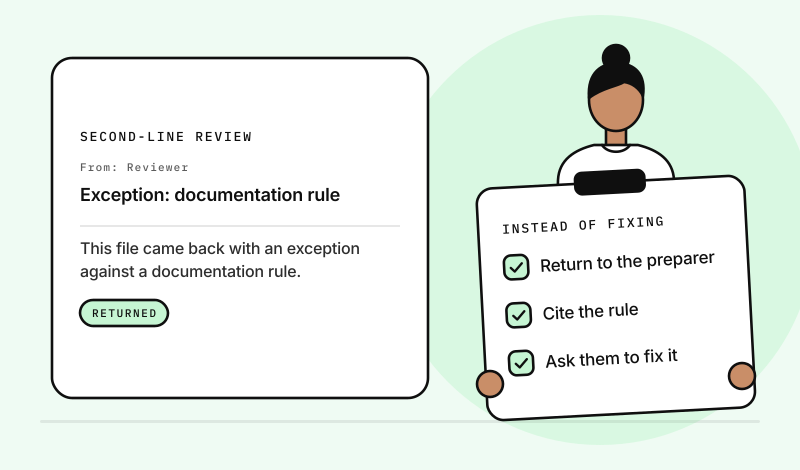
Picture a team lead in a bank's loan operations group, a few minutes before the daily cutoff. A file has come back from second-line review with an exception against a documentation rule, and the preparer who built it is already deep in the next one.
She could send it back with the rule named. Instead she fixes it herself to make the cutoff, the file clears, and next week the same exception returns while the documentation course still shows complete for everyone.
Here is that team's one-page case. Every detail is hypothetical, and the brackets are where your own figures go.
- Behavior: When a file comes back with an exception, the team lead returns it to the preparer with the rule cited and asks the preparer to fix it, instead of fixing it herself to make the cutoff.
- Cost today: Rework time per exception times [exceptions per month] times [loaded hourly rate]. Figures come from one sample supplied by [the second-line review lead]; risk exposure is described in words only.
- Estimate of change: A low, expected and high case for fewer repeat exceptions, each with its assumption beside it (for example, “if most team leads return files instead of fixing them”). A range, never a promise.
- Full cost of the test: Design and delivery, participant time, team leads' time for preparation and coaching, and the reviewer's time to sample files.
- What you will measure: In the reviewer's weekly sample of returned files, who corrected each one and whether the same exception recurred. Baseline over about four weeks before launch, checks about three weeks after launch and at 90 days, collected by [named reviewer].
- Cost of doing nothing: The cost today times [months until the next review], marked as an assumption and placed next to the cost of the test.
- Smallest test and decision rule: One team, with a comparison team left out for the same period if possible. Scale if the observed change reaches the low end of the range; rework the design if the behavior appears but the cost doesn't move; stop if the behavior doesn't appear.
In our Behavior Bridge method, the first line does the job of the Behavioral Brief: one page with a measurable behavior goal. For help phrasing that line, see a one-page training brief built to settle arguments early.
So when Thursday comes and someone asks what change they will see, you can answer with one behavior, what it costs today, a range, and a check at three weeks and again at 90 days. This week, fill in the first two lines for the proposal on your desk, including who owns the number for today's cost.
If that proposal is a refresh of a module you already have, send us the module for a free diagnostic, and we will return its three highest-impact improvements within one to two working days.
FAQ
How do you calculate training ROI for a business case?
Benefits minus costs, divided by costs, where the benefits are the monetized value of the behavior change and the costs include participant and manager time. In a first case, I'd lead with the baseline and the range and hold the single percentage until the test has produced real numbers.
How much evidence is enough for a first business case?
Enough to defend the low end of your range: one owner's sample of the cost today, your assumptions in writing, and a test designed to produce the rest.
What if I can't get any cost data at all?
Use a labeled estimate, say where it comes from, and make producing the real number part of the test. In my view, a committee accepts an honest gap far more readily when it comes with a date to close it.




Your people already sat through the training. Now get them to actually do it.
We design learning that changes what your people do on the job. No deck. No pitch. A real conversation about your people and what you need them to do differently.