

Why Transfer of Training Fails Even When Everyone Loved the Program
Transfer of training depends on the learner, the design and the workplace. Turn each into a decision before build, with a one-page sheet to fill in.


Early in the career of Julie Winkle Giulioni, a learning and development professional, a training for account associates produced lackluster results, and the cause turned out to be their managers. Looking back about 30 years later in a Summer 2024 Training Industry magazine article, Giulioni put it plainly: “It didn’t matter how wonderful the learning was if leaders weren’t prepared to support it.”
Picture the same transfer of training problem in your own week. Six weeks after a program everyone rated highly, you sit in on the team meeting and watch it run exactly as before, down to who speaks first. If you have sat in that meeting, you know the quiet walk back to your desk.

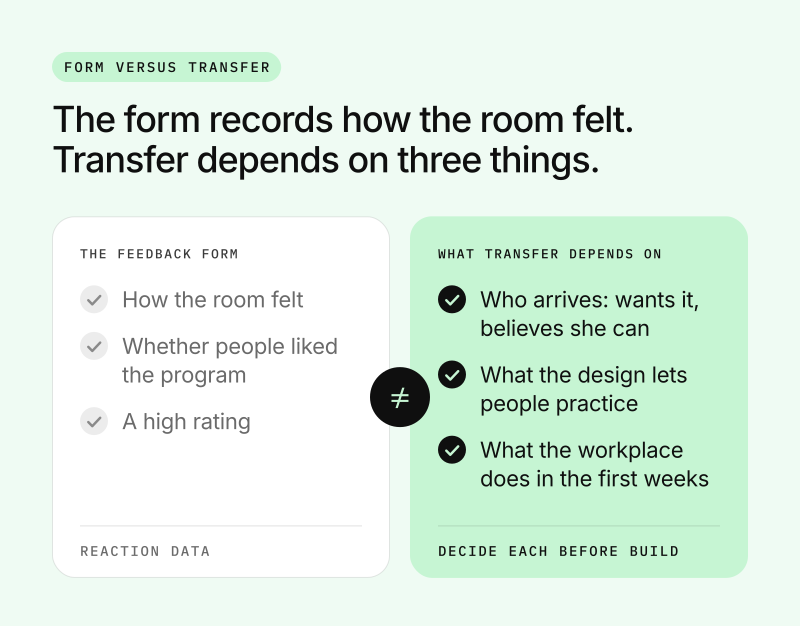
The feedback form can’t warn you, because transfer depends on three things: who arrives, what the design lets people practice, and what the workplace does in the first weeks back. You can turn each one into a decision before build. Here is the research behind them, and a one-page sheet to fill in.
Key takeaways
- Since Baldwin and Ford’s 1988 model, transfer research has grouped the predictors into the trainee, the training design and the work environment.
- A glowing feedback form records how people reacted, which says little about whether the workplace will give anyone room to try the new behavior.
- Each factor becomes a decision before build: what you ask the learner, which real work item gets practiced and who watches the first attempt.
- In a 2025 five-week study of 65 leaders, satisfaction with one week’s transfer attempt significantly predicted the next week’s transfer behavior.
- Estimates of how much training transfers are secondhand, so check your own program about three weeks after launch and again at 90 days.
What does transfer of training research say predicts change on the job?
Since Baldwin and Ford’s classic 1988 model, transfer research has sorted the predictors into three groups: the trainee, the training design and the work environment. Recent studies often still build on that model.
In a 2025 article in the International Journal of Training and Development, de Jong, Gegenfurtner and Quesada-Pallarès describe individual, organizational and training design factors that have “consistently been found to influence transfer of training.” I cite the 1988 model through their description, and my labels differ slightly from theirs.
- Learner: Their examples are transfer motivation and self-efficacy. Does she want to use it, and does she believe she can?
- Design: Their examples are the relevance of the training content and the learning strategies. What gets practiced, and on what material?
- Work environment: Their label is organizational, with social support and feedback as examples. Who notices the first try, and what do they say?
In my view, the research is less settled on exact factors than a tidy diagram suggests. I use the three groups to sort where to look; how much each one weighs in your organization is something only your own checks will show.
How much training actually transfers, and can you trust the number?
No single figure is solid enough to show your VP. AMEE Guide No. 176, a 2024 guide on teaching for transfer in health professions education by Cecilio-Fernandes, Sandars, Gianotto-Oliveira and Steenhof, cites a review outside that field estimating that only 15% to 30% of training is transferred to the workplace, and says that rate has stayed stable over three decades.
That is a secondhand estimate about other people’s programs, written for medical educators, so I’d use it as rough context and stop there.
“Fine, but the research is mixed. How much evidence is enough?” Two checks of your own, about three weeks after launch and again at 90 days, will defend a program better than anyone else’s percentage. The dates are my own recommendation; the research doesn’t supply them.
Which transfer decisions belong to the course?
Two of the three factors sit partly inside the course: what you learn about the learner before day one, and what the design lets her practice. You settle both before anyone opens a storyboard.
On the learner side, I’d start with one pre-work question: where in the next two weeks will you have to do this, and what would stop you? On the design side, the AMEE guide lists the opportunity to transfer among the conditions for successful transfer, so I’d have people rehearse the reply to a real request from their own queue.
- Instead of: Reading the feedback score and assuming the behavior will follow.
- Try: Deciding before build who will see the first attempt and where it will happen.
As for the feedback score, I’d treat it as reaction data, not a transfer forecast. It tells you how the room felt, and the work-environment group sits entirely outside that room. (A form can ask whether the coffee was good. It can’t ask what happens at next Thursday’s huddle.)
What should the workplace do in the first weeks back?
Give the first attempt a place to happen and a fair chance of going well, because the first try seems to shape the next one.
A 2025 study by Diekmann and Pundt surveyed 65 leaders who had attended various leadership trainings, once a week for five consecutive weeks. Satisfaction with transfer experiences in one week significantly predicted transfer behavior the following week, after controlling for the previous week’s behavior.
It is a small, self-reported study of leaders over five weeks, so I wouldn’t stretch it to every employee or to the long term. De Jong and colleagues also list social support and feedback among the organizational factors, which is the research version of Giulioni’s point about leaders.
“Fine, but my managers have no time to support anything.” Fair. I’d ask each manager for one thing: one behavior to look for and one place to write down what they saw, the same idea as what managers do on the Monday after a workshop.
What does a transfer decision sheet look like once it is filled in?
It is one page with seven lines: the behavior, one decision per factor, a first-attempt slot, the manager’s single job and two checks. Here it is applied to a hypothetical Thursday huddle.
Picture a team lead in the operations unit of a financial-services firm, at the Thursday huddle. It is the first since her associates finished a program on declining a colleague’s request for an approval outside the standard, and this short standing meeting has run the same way for years.
One associate liked the program and tries it, stating the standard and offering the compliant alternative. The team lead has a queue to clear and isn’t sure what the program asked of her.
- Without a plan: She says “We don’t have time for this, just approve it,” and the associate drops the new approach. By the next huddle nobody has tried it, though the feedback forms still say the program was excellent and the huddle runs as it always did.
- With a plan: Before launch she was given one behavior to look for and a two-minute slot. She asks “What did you try?”, names what worked before suggesting changes, and writes one line in a shared note. The associate tries again the following week.
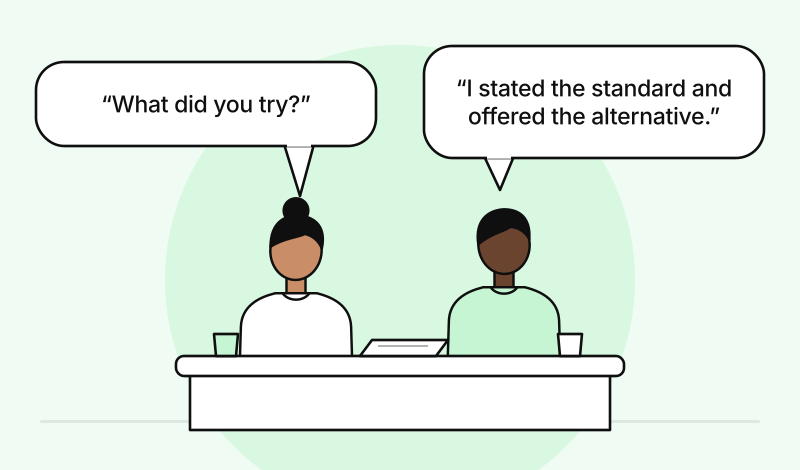
Here is the sheet behind the second version. Every detail is hypothetical, so swap in your own behavior, roles and meetings.
- Behavior: In the Thursday huddle, when a colleague asks for an approval outside the standard, an associate states the standard and offers the compliant alternative.
- Learner: One pre-work question: “Where in your next two weeks will you have to say this out loud?”
- Design: Each associate brings one anonymized request from their own queue and rehearses the reply.
- First attempt: A two-minute slot in the next Thursday huddle, agreed on before launch.
- Manager’s one job: The team lead asks “What did you try?” and adds one line to a shared note.
- Make the first try go well: I’d have the team lead name what worked before suggesting changes, because the 2025 leadership study linked satisfaction with one week’s attempt to the next week’s behavior (self-reported, leaders only).
- Two checks: About three weeks after launch and again at 90 days, looking for the standard stated aloud in the huddle and attempts recorded in the note, as in how to measure what changes after training.
In our Behavior Bridge method, the Behavioral Brief settles the first line: one page with a measurable behavior goal. The other six lines depend on it, and you can start from a one-page brief that settles the behavior question early.
“The course already exists, and my VP wants it out by Q3.” The sheet still works, because lines four to seven don’t touch the build at all.

What will be different at the next week-six meeting?
The next time you sit in on that meeting, six weeks after a well-rated program, you know what to look for: the one behavior, the two-minute slot where the first attempt happens, and the team lead who asks “What did you try?” and writes down the answer. This week, pick one program your people rated highly and fill in line one of the sheet.
If a program in your catalog rated well and the work still looks the same, send us that one existing module for a free diagnostic, and we’ll return the three highest-impact improvements within one to two working days.
FAQ
Is this a coaching issue or a training issue?
Sort it with the three factors. If people practiced the behavior well but the workplace gives it no room, a better course won’t fix it, and the work lies with managers and routines. The first question I’d ask is whether they could do it if their job depended on it.
When should I check whether transfer happened?
I recommend about three weeks after launch and again at 90 days, with one observable sign each time. A manager’s note from a real meeting tells you more than a survey of learners.
What if the course already exists and the date is fixed?
Fill in the first-attempt slot and the manager’s one job anyway, since neither needs a rebuild. If your VP wants the course by Q3, ask for one week first and use it to name the behavior.

Your people already sat through the training. Now get them to actually do it.
We design learning that changes what your people do on the job. No deck. No pitch. A real conversation about your people and what you need them to do differently.